Massachusetts Housing Market 2026: Prices, Sales & Trends
What homes actually sell for in Massachusetts: a median closed sale price of $670,000 across 40,064 closings Resideline tracked over the last six months, plus the state's largest markets by volume.
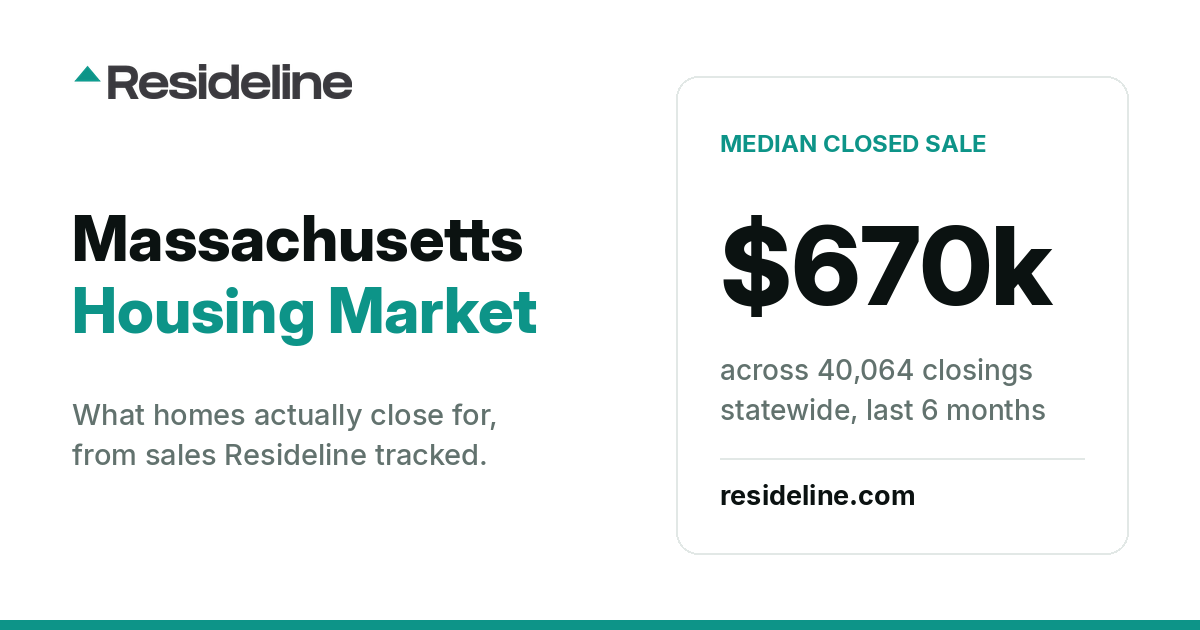
Massachusetts's median closed sale price is $670,000, measured across 40,064 closings Resideline tracked statewide over the last six months, as of October 2026. These are closings we track directly, a measured sample rather than a complete state record, which is why we can show the detail below at all. A statewide median hides how far apart Massachusetts's markets sit. Among its highest-volume markets, Newton carries the highest median and Springfield the lowest. That gap is the reason a state figure belongs in a market briefing rather than in an offer: it describes the middle of the distribution, not a price you can underwrite against.
Massachusetts's largest markets by closing volume
| Market | Closings tracked, last 6 months | Median closed sale |
|---|---|---|
| Boston | 1,970 | $930,000 |
| Springfield | 825 | $315,000 |
| Worcester | 782 | $480,000 |
| Plymouth | 686 | $675,000 |
| Cambridge | 535 | $1,255,000 |
| Newton | 448 | $1,550,000 |
| Quincy | 446 | $680,000 |
| Haverhill | 442 | $531,750 |
| Somerville | 433 | $1,050,000 |
| Lowell | 426 | $508,500 |
Volume matters as much as price here. Higher transaction volume generally provides more potential comparable sales, although the usable set for a specific property still depends on property type, size, condition, location and recency.
Rankings for Massachusetts: best places to buy rental property in Massachusetts ranks cities by asking rental yield from tracked sales and rental listings, cheapest cities to buy a house in Massachusetts adds each city's price per square foot for houses, realized appreciation and days to contract, and Cap Rate by City ranks the Massachusetts cities Resideline tracks by gross rental yield.
More Massachusetts research: housing market reports for Fitchburg, Waltham, and Salem.
More Massachusetts city reports: Andover · Arlington · Framingham · Melrose · Methuen · Natick · Needham · Reading · Shrewsbury · Watertown · Wellesley · Woburn.
Figures last updated October 4, 2026 from closings Resideline tracked.
How to price a specific Massachusetts property
Work from the closings, not from the state number. Start with sales of the same property type inside a tight radius, match size and condition before you widen anything, and treat the figures above as a sanity check on the answer rather than as the answer. A statewide median is useful for spotting which markets deserve attention; it will mis-price an individual address in either direction.
Run any Massachusetts address through Resideline and you will get the local comparable set and the property's value together, in one report.
Frequently Asked Questions
What is the median home price in Massachusetts?
The median closed sale price in Massachusetts is $670,000, measured across 40,064 closings Resideline tracked statewide over the last six months as of October 2026.
Which Massachusetts markets are most and least expensive?
Among the Massachusetts markets we track with the most closings, Newton has the highest median closed sale at $1,550,000 and Springfield the lowest at $315,000. Both are measured from closings Resideline tracked over the last six months.
What could a property in Massachusetts be worth?
Create a free account to explore a Massachusetts property's value, rental potential and comparable properties.
Create a free account3 free reports at signup. No card required.