How the 2026 Midterm Elections Affect the Housing Market
Democrats are projected to control Congress from January, with a Republican president. Much of what changes for real estate in 2027 is already set, including a purchase limit for investors with 350 or more single-family homes that starts January 7.
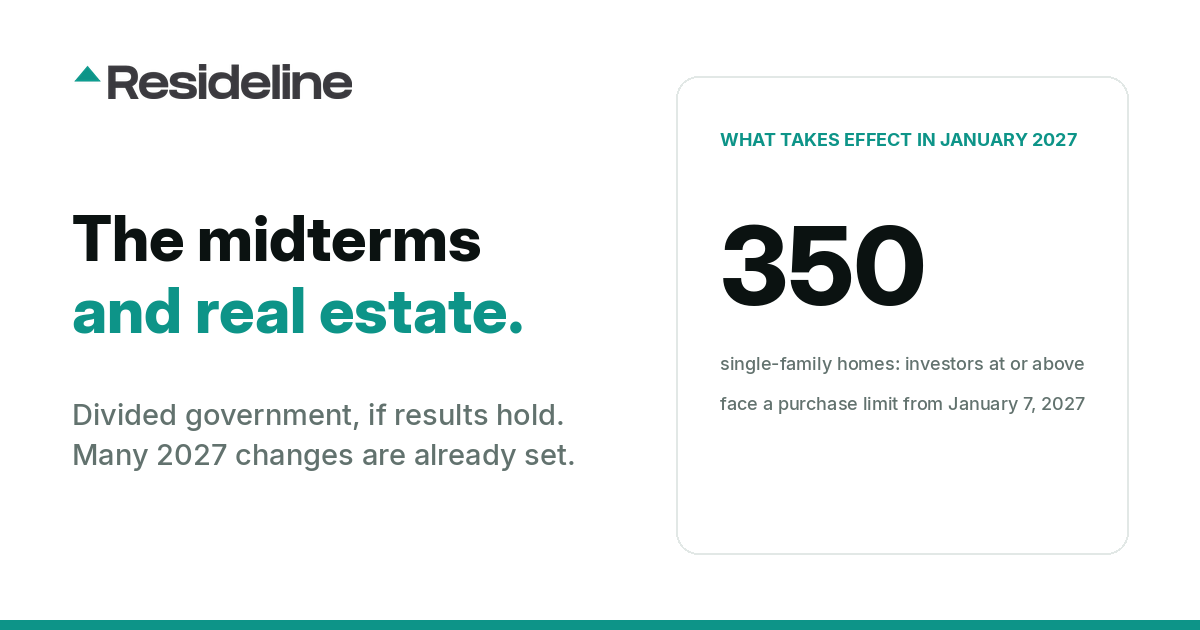
Democrats won control of both the House and the Senate in the November 3, 2026 midterm elections, according to network projections. With a Republican president, the federal government would be divided from January 3, 2027. These results are unofficial as of November 6, 2026: about 20 House races were still uncalled, as were the Senate races in Mississippi and Alaska, and certification continues into December in some states, including California on December 11.
For real estate, the split matters most for what Congress can pass. Democrats are not projected to reach the two-thirds majority needed to override a veto in either chamber, so a new federal housing law in 2027 or 2028 would need a Democratic Congress and a Republican president to agree, or enough votes from both parties to override a veto. Much of what changes next year is already on the calendar: new opportunity zones and a higher tariff on imported cabinets and vanities on January 1, then a purchase limit on January 7 for investors that control 350 or more single-family homes. Florida voters approved Amendment 3, which raises the homestead exemption from non-school property taxes to $150,000 in 2027 and $250,000 in 2028.
Mortgage rates move with Treasury yields, which respond to inflation and Federal Reserve policy. The 30-year fixed rate was 7.18% on November 5, 2026, its third straight weekly decline, according to the weekly national mortgage rate survey. After past midterms, home prices and mortgage rates in the following year looked much like they did in other years.
What the election changed in Washington, and what it did not
Republicans held the Senate 53 to 47 going into the vote. Network projections give Democrats at least 54 Senate seats and the House. A veto override takes two-thirds of those voting, 290 in the House and 67 in the Senate when all members vote, and Democrats are not projected to reach that in either chamber.
The 21st Century ROAD to Housing Act (Public Law 119-101), enacted on July 11, 2026 without the President's signature, sets the January 7, March 8 and July 11 dates below, and federal agencies are still writing rules under it.
Already on the calendar: the 2027 dates that matter
| Date | What takes effect | Who it affects |
|---|---|---|
| January 1, 2027 | 6,576 new opportunity zone census tracts, 2,594 of them rural, designated through 2036 | Investors and developers in those tracts |
| January 1, 2027 | Tariff on imported kitchen cabinets and bathroom vanities rises from 25% to 50%, with exceptions | Flippers, remodelers and builders |
| January 3, 2027 | New Congress takes office | Anyone waiting on new housing or tax laws |
| January 7, 2027 | Investors controlling 350 or more single-family homes may not buy more, with exceptions, for 15 years | Large investors, and the owners and smaller investors who sell to them |
| March 8, 2027 | Deadline for FHA appraiser guidance under the ROAD to Housing Act | FHA borrowers and appraisers |
| July 11, 2027 | Deadline for CDBG disaster recovery and HOME program rules | Local housing programs that use those funds |
The large investor purchase limit
Section 1001 of the ROAD to Housing Act bars an investor that controls 350 or more single-family homes (one- and two-unit homes, as the law defines them), alone or with affiliates, from buying more of them from January 7, 2027 to January 7, 2042, according to the Congressional Research Service's October 20, 2026 report on the law. It does not force sales of homes already owned, manufactured homes are excluded, and investors below 350 homes are not affected.
Exceptions include build-to-rent, renovate-to-rent, homes renovated for resale, lease-to-own, purchases through foreclosure or loss mitigation, certain purchases from other large investors, and purchases from smaller investors until January 7, 2029. Treasury proposed rules for the limit in October 2026, and under that proposal a renovate-to-rent buyer would have to spend at least 15% of the purchase price on improvements, according to the Small Business Administration's Office of Advocacy (October 26, 2026). Comments on the proposal are due November 23, 2026, so the rule is not final.
For investors below the line, the likely effect is on competition. After January 7, large investors can still buy when a purchase fits one of those exceptions, so how much that competition eases depends on how often they apply.
New opportunity zones
Treasury announced the 6,576 new tracts on November 5, 2026, and the designations run from January 1, 2027 through 2036. Before counting on the tax treatment, check the property's census tract against Treasury's designations and ask a tax adviser.
Tariffs on building materials
The Section 232 tariff of 10% on softwood lumber stays in place. On January 1, 2027, the tariff on imported kitchen cabinets and bathroom vanities rises from 25% to 50%, under a presidential proclamation published in the Federal Register on January 9, 2026. The increase does not apply to countries that reach an agreement with the United States. Flippers pricing a kitchen or bath for next year may want quotes at the higher rate.
Taxes: what is law and what is only proposed
Public Law 119-21 set the cap on the federal deduction for state and local taxes (SALT) at $40,400 for 2026, in Section 164 of the Internal Revenue Code. The cap rises 1% a year through 2029, phases down for high earners and returns to $10,000 in 2030 unless Congress changes it.
The home sale capital gains exclusion is unchanged at $250,000 for single filers and $500,000 for married couples filing jointly. No bill to change it has become law; H.R. 4327, for example, is still in committee, according to Congress.gov. Changing either one would take a new law, so plan any sale or purchase in 2027 under today's rules.
State ballots: property taxes and housing bonds
Percentages are unofficial and come from local news reports.
| State | Measure | What it does | Result |
|---|---|---|---|
| Florida | Amendment 3 | Raises the non-school homestead exemption; cuts the non-homestead assessment cap from 10% to 5% | Passed, about 62% (60% needed) |
| North Carolina | Constitutional amendment | Requires a cap on growth in local property tax levies; the legislature sets the cap | Passed, about 60% |
| Tennessee | Amendment 2 | Bans a state property tax; local property taxes unaffected | Passed |
| Wyoming | Proposition 1 | Would have exempted 50% of a primary home's assessed value | Failed, about 43% yes |
| Oklahoma | State Question 847 | Would have lowered caps on yearly assessment increases | Failed, about 46% yes |
| California | Proposition 1 | $11.25 billion housing bond | Passed (projected), about 60% |
| California | Proposition 37 | Up to $25 billion in state housing finance agency second mortgages for buyers of new homes | Passed (projected), about 62% |
| Massachusetts | Question 7 | Would have allowed single-family homes on 5,000 square foot lots statewide except Boston | Failed, 49.35% yes |
| Rhode Island | Question 2 | $120 million housing bond | Passed, 61.12% |
| Hawaii | Constitutional amendment | Allows housing infrastructure bonds | Passed, 62.2% |
North Carolina's amendment does not set the cap or say when the legislature must set it, according to Spectrum News, so owners there do not yet know how tight it will be. California certifies its results on December 11, and until then Propositions 1 and 37 are projections.
Florida Amendment 3
The homestead exemption from non-school property taxes rises from about $50,000 to $150,000 in 2027 and to $250,000 in 2028, and is indexed after that. Owners who were not Florida residents on December 31, 2026 get the larger amount only from their fifth year of receiving the exemption, according to NBC Miami. For non-homestead property, which includes rentals and second homes, the cap on yearly assessment increases drops from 10% to 5%. School taxes are not affected. Local governments do not expect a significant drop in revenue until fall 2027, with a much larger one in 2028, according to Bay News 9. The median closed price across the 215,084 Florida closings Resideline tracked in the six months to October 2026 was $370,000. Our Florida Amendment 3 guide compares the new exemptions with recent sale prices city by city, and the Florida housing market report has the statewide picture.
Mortgage rates after the election
The 30-year fixed rate was 7.18% on November 5, 2026, down from 7.24% a week earlier and 7.40% on October 8 and October 15. The 10-year Treasury yield fell from 4.95% on November 3 to 4.84% on November 5, according to the St. Louis Fed's FRED database. CNBC reported that yields fell in the wake of the results and during a sharp sell-off in technology stocks, so the drop cannot be credited to the election alone.
The Federal Reserve held its policy rate at 3.75% to 4.00% on October 28, 2026, with two members dissenting in favor of a hike. Builders started homes at an annual rate of 1,221,000 in September 2026, according to the Census Bureau, and permits ran at 1,398,000.
In our look at housing affordability and the economy, a buyer's payment as a share of income moved almost in step with mortgage rates. For a specific property, run the numbers at today's rate in the deal analyzer before counting on a lower one.
What history says about housing after midterms
Federal housing data cover 12 to 16 midterms, depending on the series. We compared the year after each midterm with the same window in every other year.
| Measure | Midterms covered | Average change, year after a midterm | Average change, other years |
|---|---|---|---|
| Housing starts (Census Bureau) | 16, from 1962 to 2022 | +9.7% | -1.1% |
| Median price of new homes sold (Census Bureau) | 15, from 1966 to 2022 | +5.5% | +5.1% |
| All transactions house price index (FHFA) | 12, from 1978 to 2022 | +4.5% | +5.3% |
| 30-year fixed mortgage rate (weekly national survey) | 13, from 1974 to 2022 | -0.10 points | +0.03 points |
Prices and mortgage rates after midterms looked much like other years. Housing starts averaged a 9.7% gain after midterms against a 1.1% drop in other years, but across the 16 midterms the change ran from a 22% drop to a 59% gain, so a few large years pull the average around. The median midterm year gained 6.5%, against 1.7% in other years. The comparison describes what happened and does not show that elections caused it.
After the four most recent midterms (2010, 2014, 2018 and 2022), starts and prices grew more slowly than in other years since 2009, partly because two of those windows fell in unusual stretches: the post crisis bust around 2010 and the rate shock of 2022. In the year after the 2010 election, the FHFA index fell 4.5%. In the year after the 2022 election, housing starts fell 8.7% and the 30-year rate rose 0.72 points. The median price of new homes sold fell 3.8% in the year after the 2018 election.
Academic studies find that election uncertainty shows up in housing before the vote. Canes-Wrone and Park, writing in the British Journal of Political Science in 2014, found that home sales fall before competitive elections. A working paper by Nguyen and Vergara-Alert of IESE found that in states with a governor's race, house price growth and sales slow in the election year and recover the year after. For a single purchase, local inventory and prices are the place to start, and our guide to whether it is a buyer's market right now covers how to read them.
What to watch next
- •Final counts in the remaining House races and the Senate races in Mississippi and Alaska, and state certification over the coming weeks (California on December 11).
- •Treasury's final rule on the investor purchase limit, including the 15% renovation test in the October 2026 proposal. The limit starts January 7 under the law either way.
- •HUD and FHA rules under the ROAD to Housing Act: appraiser guidance by March 8, 2027, CDBG disaster recovery and HOME rules by July 11, 2027, and the HUD standards that would end the permanent chassis requirement for manufactured homes.
- •The Fed's next meetings, since two members dissented in favor of a hike in October, and the weekly mortgage rate survey, which will show whether the recent dip in rates holds.
- •Florida county property appraisers, who apply the larger exemption from 2027 and can say how it affects a given home.
How we measured this
The history table uses four series from the St. Louis Fed's FRED database: housing starts and the median sales price of new homes sold, both from the Census Bureau, the Federal Housing Finance Agency's all transactions house price index, and the 30-year fixed rate from the weekly national mortgage rate survey. For each year we compared a window just before the early November election with the same window a year later: the August to October average for housing starts, the October average for the mortgage rate, and the third quarter for the two price series. Using the same calendar window every year holds seasonal swings constant. "Other years" are all years that were not midterms, from the start of each series through 2025, counting only years with a full year of later data. Changes are percent changes except the mortgage rate, which is in percentage points, and the figures are simple averages.
The Florida median is across all property types in the 215,084 closings Resideline tracked in the six months to October 2026.
Sources
- •CBS News, 2026 Senate election results
- •NBC News, 2026 Senate results
- •Congressional Research Service, report R49354 on the ROAD to Housing Act (October 20, 2026)
- •SBA Office of Advocacy, Treasury's proposed rule on large investor purchases (October 26, 2026)
- •U.S. Treasury, opportunity zone designations (November 5, 2026)
- •Federal Register, amendments to the timber and lumber import tariffs (January 9, 2026)
- •Congress.gov, H.R. 4327
- •Federal Reserve, October 28, 2026 policy statement
- •St. Louis Fed, FRED database
- •CNBC, Treasury yields after the election (November 5, 2026)
- •NBC Miami, Florida Amendment 3 result
- •CBS12, Amendment 3 passes with 62% of the vote
- •Bay News 9, Florida voters approve Amendment 3
- •WUNC, North Carolina constitutional amendments
- •Spectrum News, North Carolina property tax limit
- •WSMV, Tennessee Amendment 2
- •WyoFile, Wyoming Proposition 1
- •News On 6, Oklahoma State Question 847
- •CalMatters, California propositions
- •NBC Bay Area, California proposition results
- •WBUR, Massachusetts Question 7
- •NBC Boston, Massachusetts ballot question results
- •Providence Business News, Rhode Island bond results
- •Civil Beat, Hawaii housing bond amendment
Frequently Asked Questions
How do the midterm elections affect the housing market?
Mostly through what Congress can pass. With Democrats projected to control both chambers and a Republican president, a new federal housing law in 2027 or 2028 would need both sides to agree or a two-thirds vote to override a veto, so many of the 2027 changes are ones already on the calendar. In federal data going back to the 1960s and 1970s, home prices and mortgage rates in the year after a midterm looked much like other years.
What is the large investor home purchase limit that starts in 2027?
Under Section 1001 of the 21st Century ROAD to Housing Act, an investor that controls 350 or more single-family homes, counting affiliates, may not buy more single-family homes from January 7, 2027 to January 7, 2042. It does not force sales of homes already owned and does not cover manufactured homes. Exceptions include build-to-rent, renovate-to-rent, homes renovated for resale, lease-to-own, foreclosure and loss mitigation purchases, certain purchases from other large investors, and purchases from smaller investors until January 7, 2029. Investors with fewer than 350 homes are not affected.
Will mortgage rates fall because of the election?
Past midterms do not point to an election effect on rates. Across 13 midterms from 1974 to 2022, the 30-year rate changed by an average of -0.10 points in the following year, close to the +0.03 points in other years. The 30-year fixed rate was 7.18% on November 5, 2026, its third straight weekly decline, and the Federal Reserve held its policy rate at 3.75% to 4.00% on October 28, 2026.
What did Florida Amendment 3 change?
It raises the homestead exemption from non-school property taxes from about $50,000 to $150,000 in 2027 and $250,000 in 2028, then indexes it. It also cuts the cap on yearly assessment increases for non-homestead property, such as rentals and second homes, from 10% to 5%. School taxes are not affected, and people who were not Florida residents on December 31, 2026 get the increase only from their fifth year of receiving the exemption. The measure passed with about 62% of the vote, above the 60% it needed.
What changes for opportunity zones in 2027?
Treasury announced on November 5, 2026 that it had designated 6,576 new census tracts as opportunity zones, 2,594 of them rural. The designations take effect January 1, 2027 and run through 2036. Check a property's census tract against Treasury's designations before counting on the tax treatment, and confirm the details with a tax adviser.
Did the election change the capital gains exclusion on home sales?
No. The exclusion stays at $250,000 for single filers and $500,000 for married couples filing jointly. No bill to change it has become law; H.R. 4327, for example, is still in committee. Any change would take a new law.

About the author
Jeffrey Batista
Jeffrey Batista is the founder of Resideline, a real estate technology company building institutional grade valuation and investment analysis tools for real estate investors.
A software engineer with more than 10 years of experience, Jeffrey has worked across full stack development, infrastructure, data engineering, machine learning, and large scale systems. He left his engineering career to build Resideline full time.
Jeffrey is also a real estate investor with nearly a decade of hands on experience buying, renovating, managing, and analyzing residential properties. His experience on both sides of the industry, as an engineer and an investor, led him to build Resideline after seeing how fragmented and outdated many of the tools available to individual investors were.
Today, he leads the development of Resideline's proprietary data infrastructure, automated valuation models, rental analytics, and investment underwriting technology.
Check the evidence behind your property’s value.
Create a free account to inspect comps and the assumptions behind your property’s estimated value.
See this for a real address3 free reports at signup. No card required.