Florida Amendment 3: What the Property Tax Vote Changes
Florida voters approved Amendment 3, raising the non-school homestead exemption to $150,000 in 2027 and $250,000 in 2028 and cutting the non-homestead assessment cap to 5%. We show what those amounts cover at median prices in 15 cities.
Florida voters approved Amendment 3 on November 3, 2026, with about 62% voting yes, above the 60% a constitutional amendment needs in Florida. These results are unofficial as of November 6, 2026. Several races around the country were still uncalled that day, and the Amendment 3 result had not yet been certified.
The amendment raises the homestead exemption for county, city and other non-school property taxes to $150,000 of assessed value on January 1, 2027, and to $250,000 on January 1, 2028. School taxes keep the current $25,000 exemption. Rentals, second homes and commercial property get no homestead exemption. For them, the yearly limit on increases in assessed value for non-school taxes falls from 10% to 5%, also starting January 1, 2027.
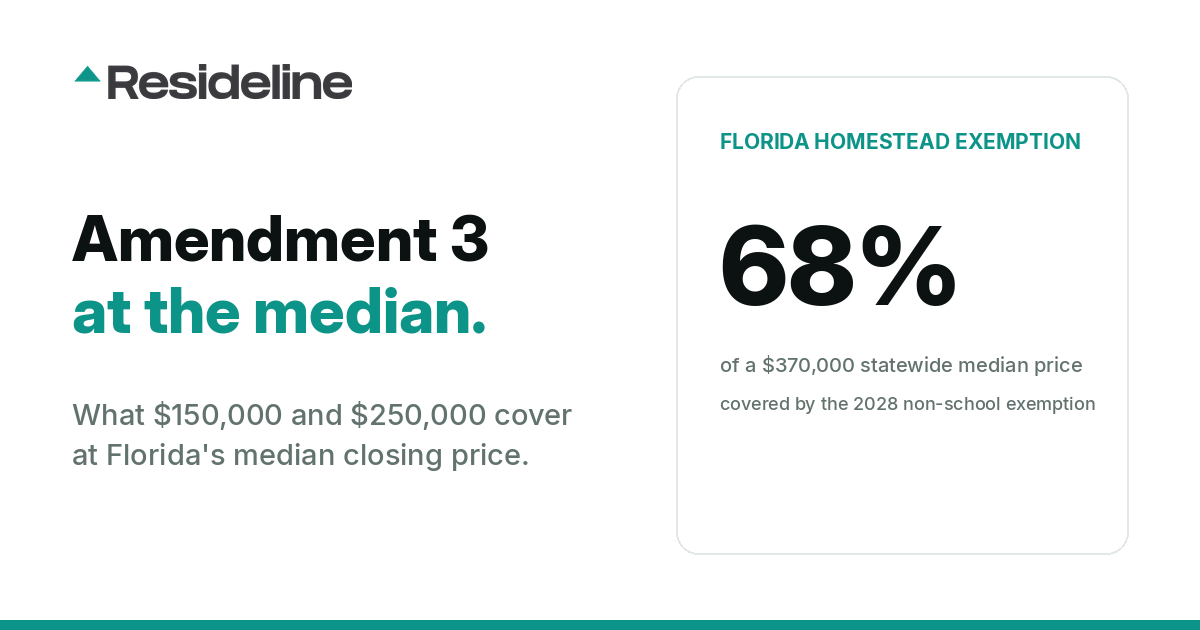
Across the 215,084 Florida closings Resideline tracked in the six months to October 2026, the median price was $370,000. A $150,000 exemption equals 41% of that median sale price, and $250,000 equals 68%. For a recent buyer whose assessed value sits close to the purchase price, that is roughly the share of assessed value the exemption would cover for non-school taxes; it is not the drop in a tax bill. School taxes keep the $25,000 exemption, owners who were not Florida residents on December 31, 2026 start at $50,000, and no dollar savings can be worked out from these shares because 2027 and 2028 tax rates have not been set.
What the amendment changes
Amendment 3 comes from CS/HJR 1F, a joint resolution the Legislature passed in June 2026, 75 to 26 in the House and 30 to 9 in the Senate. It was filed with the Secretary of State on June 16, 2026. The provisions below are taken from the enrolled text and the House's final bill analysis.
| Provision | Under Amendment 3 | Starts |
|---|---|---|
| Homestead exemption, non-school taxes | $150,000 of assessed value (2026 maximum: $51,411) | January 1, 2027 |
| Homestead exemption, non-school taxes | $250,000 of assessed value | January 1, 2028 |
| Inflation adjustment | The $250,000 rises each year with the consumer price index, when that change is positive | January 1, 2029 |
| Homestead exemption, school taxes | Stays at $25,000 | No change |
| Assessment cap on non-homestead property, non-school taxes | 5% a year, down from 10% | January 1, 2027 |
| Owners who were not Florida residents on December 31, 2026 | $50,000 of assessed value exempt from non-school taxes and $25,000 from school taxes, then the full non-school amount from the fifth year of exemption | January 1, 2027 |
| Save Our Homes cap on homestead assessments | Unchanged at 3% or the change in the consumer price index, whichever is lower | No change |
The 2026 figure comes from the Leon County Property Appraiser, which puts this year's maximum homestead exemption at $51,411: $25,000 against all taxes plus $26,411 against non-school taxes. NBC6 in Miami reported the same $51,411, citing the Florida Department of Revenue.
Two other parts of the amendment affect local budgets. From 2027, counties and cities may spend property tax revenue only on a list of purposes that includes public safety, schools, infrastructure, natural resource and flood control projects, debt payments, employee retirement costs, the operations of county officers and city governments, and other spending their governing bodies approve unless general law prohibits it. The amendment also directs the Legislature to write a procedure that lets counties and cities raise the exemption further for their own levies, up to the full assessed value, and it lets special districts do the same by referendum.
Which taxes the larger exemption reaches
Florida property taxes are levied by counties, cities, school districts and some special districts, as the House analysis describes them. The new exemption applies to "all levies other than school district levies," in the amendment's words, so the school portion of a homeowner's bill is still figured on assessed value minus $25,000. NBC6 and CBS12 both reported the school portion as unchanged.
The Leon County Property Appraiser's explainer adds two limits. Homestead exemptions "do not reduce non-ad valorem assessments," so those charges stay wherever local governments set them. And while the exemption lowers taxable value, each taxing authority still adopts its own rate every year. When homestead taxable values fall, the "rolled-back rate" a local government calculates (the rate that would raise about the same revenue as the year before) comes out higher, producing what the appraiser calls "effectively a 'rolled-up rate.'" A governing board can adopt that rate, a lower one, or another rate the law allows.
Moving to Florida after 2026
The amendment sorts homeowners by where they lived on December 31, 2026.
- •People who were Florida permanent residents on that date get the larger exemption from 2027 once they have a homestead. That includes residents who had not yet bought a home by then, according to the Leon County Property Appraiser.
- •Someone who had not kept a permanent residence in Florida as of December 31, 2026 and sets up a homestead on or after January 1, 2027 has $25,000 of assessed value exempt from school taxes and $50,000 exempt from other taxes. The $50,000 is adjusted for inflation starting in 2028. Beginning with the fifth year of the exemption, that owner gets the same non-school amount as everyone else.
- •Starting in 2030, a county or city can vote, by two thirds of its governing body, to shorten the five-year wait when it finds a critical local need.
At the statewide median of $370,000, the $50,000 newcomer exemption covers about 14% of the price, compared with 41% in 2027 and 68% from 2028 for someone who was a resident by the end of 2026. NBC6 described the newcomer rule as applying "subject to what is permitted under the U.S. Constitution." Leon County's appraiser says it is still waiting for state guidance on implementation, including whether owners will need to provide documentation. If you moved to Florida near the end of 2026, ask your county property appraiser how residency on December 31 will be established.
What $150,000 and $250,000 cover in 15 Florida markets
Each row shows the median closed price in one of the 15 Florida markets with the most closings Resideline tracked in the six months to October 2026, sorted by number of closings. The medians are taken across closed sales of all property types inside each market's boundary (city limits for incorporated cities; for Lehigh Acres and The Villages, their census-designated place; for Parrish, the larger Parrish census county division) and are the same figures shown on each market's housing market page; the statewide line matches our Florida housing market report. The two share columns divide each exemption amount by that median. Each share counts the whole exemption, and the 2026 exemption already covers up to $51,411 of assessed value for non-school taxes, so the increase is smaller than the share.
| City | Closings (6 months) | Median closed price | $150,000 share (2027) | $250,000 share (2028) |
|---|---|---|---|---|
| Jacksonville | 7,071 | $293,000 | 51% | 85% |
| Cape Coral | 3,316 | $369,990 | 41% | 68% |
| Tampa | 2,924 | $435,000 | 34% | 57% |
| Port St. Lucie | 2,844 | $399,000 | 38% | 63% |
| St. Petersburg | 2,505 | $403,000 | 37% | 62% |
| Miami | 2,280 | $655,000 | 23% | 38% |
| Lehigh Acres | 1,918 | $305,950 | 49% | 82% |
| Fort Lauderdale | 1,881 | $585,000 | 26% | 43% |
| Orlando | 1,793 | $414,990 | 36% | 60% |
| Palm Bay | 1,716 | $322,890 | 46% | 77% |
| Palm Coast | 1,447 | $355,000 | 42% | 70% |
| The Villages | 1,306 | $360,500 | 42% | 69% |
| Miami Beach | 1,288 | $465,000 | 32% | 54% |
| Parrish | 1,263 | $400,000 | 38% | 63% |
| Tallahassee | 1,165 | $290,000 | 52% | 86% |
| Florida, all closings | 215,084 | $370,000 | 41% | 68% |
In Jacksonville, where the median closing price was $293,000, the 2028 exemption equals 85% of the median. In Miami, at $655,000, it equals 38%; our Miami housing market report has more on prices there. In 18 of the 225 Florida cities in our data, the median closing price was $250,000 or less. A home bought at the median in one of those cities and assessed at that price would have no taxable value left for non-school taxes in 2028, for an owner who qualifies for the full exemption. School taxes and non-ad valorem assessments would still apply.
Read the table as an illustration for a recent buyer. The exemption comes off assessed value, which is the property appraiser's figure, and that can be lower than the price a home would sell for. For homesteads, Save Our Homes limits each year's increase in assessed value to 3% or the change in the consumer price index, whichever is lower, and the assessment resets to just value on the January 1 after a sale, unless the buyer brings over a Save Our Homes benefit from a previous Florida homestead. When prices rise faster than that cap allows, an owner's assessed value falls behind the market. Leon County's appraiser notes that "recent buyers often have taxable values closer to market value," which is why the table fits them best. For an owner whose assessed value is well below market, the same exemption covers a larger share.
The table shows no dollar savings because tax rates differ by county, city and special district, and the rates for 2027 and 2028 have not been set. "Actual savings cannot be determined until implementing legislation is finalized and future tax rates are established," the Leon County office says. Your county property appraiser is the place to get an estimate for a specific home.
What changes for landlords, second homes and investors
The homestead exemption covers only a home that is the owner's permanent residence. Rental property, commercial property, second homes and vacant land are all non-homestead property in the Leon County appraiser's examples, and none of them gets the larger exemption.
Non-homestead owners get the lower cap instead. Starting January 1, 2027, the assessed value used for non-school taxes can rise by no more than 5% a year, down from 10%. The enrolled text applies the 5% limit to residential property with nine units or fewer and to all other non-homestead real property. School taxes stay on full just value with no cap, which the House analysis notes was already true under the 10% limit.
Several details decide what the cap is worth on a given property:
- •The cap starts over when a property sells. Non-homestead property is generally reassessed at just value on the January 1 after a change of ownership, according to the House analysis, and the amendment keeps that rule for residential property of nine units or fewer, including when ownership of a company that holds the property changes. A rental bought in 2027 gets its first capped increase only after that reset.
- •Improvements are generally assessed at just value on the January 1 after they are made, the House analysis says, so a renovation can lift an assessment by more than 5% in one year.
- •The cap applies to assessed value. Tax bills still depend on rates, and the Polk County Property Appraiser's FAQ says the cut from 10% to 5% "only caps assessed value, not taxes."
- •In a year when a property's assessment would have risen less than 5% anyway, the lower cap changes nothing.
If you are underwriting a Florida rental for 2027 or later, start from the assessed value the property is likely to get after the sale reset and from current local rates, then recheck the numbers when the August 2027 TRIM notices arrive. Our guide to rental property cash flow shows where property tax fits in the math, and you can run a specific property through the deal analyzer.
Timing and local budgets
The amendment takes effect January 1, 2027, and it does not change 2026 tax bills. According to the Leon County Property Appraiser, the changes will first show on the August 2027 notices of proposed property taxes, known as TRIM notices, and on the bills mailed in November 2027.
Before the vote, the state's Revenue Estimating Conference estimated that local non-school property tax revenue would be $4.95 billion lower in fiscal year 2027-28, with the $150,000 exemption in place, and $8.78 billion lower in 2028-29, with $250,000 in place, according to the House's June 2026 final bill analysis. It put the recurring reduction at $11.86 billion a year. Bay News 9 reported that local governments did not expect a significant drop in revenue until fall 2027 and a much larger one in 2028, and that Tampa prepared two 2027 budgets, one for each outcome of the vote.
CBS12 reported that the amendment does not automatically require counties or cities to cut programs or police staffing, since those decisions depend on local budgets. In the same report, supporters described the measure as relief for homeowners as housing costs rise, and opponents warned of reduced funding for police, infrastructure and other services. For how the national results bear on housing, see our companion article on the 2026 midterm elections and the real estate market.
How we measured this
The Resideline figures cover closings we tracked in Florida in the six months to October 2026, with October 2026 as the data month. Statewide, that is 215,084 closings with a median closed price of $370,000. The 15 cities in the table are the ones with the most closings among the 225 Florida cities in our data; together they account for 34,717 of the statewide closings, and the table is sorted by closings only. The city figures are medians of closed sales Resideline tracked inside each market's boundary (city limits, or the Census area named above for Lehigh Acres, The Villages and Parrish) over the six months to October 2026, across property types, the same figures shown on each city's housing market page.
Each share is the exemption amount divided by the median closed price, rounded to the nearest whole percent with halves rounded up (Parrish's 62.5% shows as 63%), and assumes an assessed value equal to that price.
Sources
- •Florida Senate: CS/HJR 1F (2026F session), bill history and versions
- •Florida Legislature: CS/HJR 1F, enrolled text
- •Florida House of Representatives: CS/HJR 1F final bill analysis, June 16, 2026
- •Florida Senate: CS/HJR 1F bill summary, 2026F session
- •Leon County Property Appraiser: Amendment 3, Florida property tax changes
- •Polk County Property Appraiser: Amendment 3 FAQ
- •NBC6 Miami: Florida Amendment 3 election result
- •CBS12: Amendment 3 passes with 62% of the vote
- •Bay News 9: Florida voters approve Amendment 3
Frequently Asked Questions
When does Florida Amendment 3 take effect?
The amendment takes effect January 1, 2027, and it does not change 2026 property tax bills. The Leon County Property Appraiser says the changes will first appear on the August 2027 TRIM notices and the tax bills mailed in November 2027. The non-school homestead exemption is $150,000 in 2027 and $250,000 from 2028.
Does Amendment 3 lower school property taxes?
No. The larger exemption applies only to levies other than school district levies, so the school portion of a homestead bill keeps the $25,000 exemption. The new 5% cap on non-homestead assessments also does not apply to school taxes, which stay based on just value.
I am moving to Florida in 2027. Do I get the $250,000 exemption?
Not at first. An owner who had not kept a permanent residence in Florida as of December 31, 2026 has $50,000 of assessed value exempt from non-school taxes and $25,000 from school taxes, and the full non-school amount starts with the fifth year of the exemption. From 2030, a county or city may vote by two thirds to shorten that wait for a critical local need. Ask your county property appraiser how residency on December 31, 2026 will be established; the Leon County office says it is still waiting for state guidance.
Does the homestead exemption apply to a rental property or second home?
No. The exemption covers only a home that is the owner's permanent residence. Rentals, second homes, commercial property and vacant land instead get a lower cap: from January 1, 2027, their assessed value for non-school taxes can rise no more than 5% a year, down from 10%. That cap generally starts over at just value after the property sells.
How much will Amendment 3 save me on property taxes?
It depends on your assessed value, your exemptions and the tax rates your county, city and special districts adopt for 2027 and 2028, which have not been set. The exemption comes off assessed value, which can be lower than market value for longtime homestead owners because of the Save Our Homes cap. Your county property appraiser is the best source for an estimate on a specific home.
Is the new homestead exemption adjusted for inflation?
Yes, from January 1, 2029, the $250,000 amount is adjusted each year using the consumer price index for urban consumers, but only when that change is positive. The $50,000 exemption for owners who were not Florida residents at the end of 2026 is adjusted the same way starting in 2028.

About the author
Jeffrey Batista
Jeffrey Batista is the founder of Resideline, a real estate technology company building institutional grade valuation and investment analysis tools for real estate investors.
A software engineer with more than 10 years of experience, Jeffrey has worked across full stack development, infrastructure, data engineering, machine learning, and large scale systems. He left his engineering career to build Resideline full time.
Jeffrey is also a real estate investor with nearly a decade of hands on experience buying, renovating, managing, and analyzing residential properties. His experience on both sides of the industry, as an engineer and an investor, led him to build Resideline after seeing how fragmented and outdated many of the tools available to individual investors were.
Today, he leads the development of Resideline's proprietary data infrastructure, automated valuation models, rental analytics, and investment underwriting technology.
Put this research to work on a real property.
Create a free account to explore property value, rental potential and comparable properties.
See this for a real address3 free reports at signup. No card required.