Does the 1% Rule Still Work? It Survives in 9 of 628 Markets
The 1 percent rule says a rental should gross monthly rent of at least 1 percent of its price. Tested against 12 months of observed rents from rental listings that left the market in 628 US cities (postal areas), it survives in exactly 9, or 1.43 percent. The median city yields 6.53 percent gross, about half of what the rule demands.
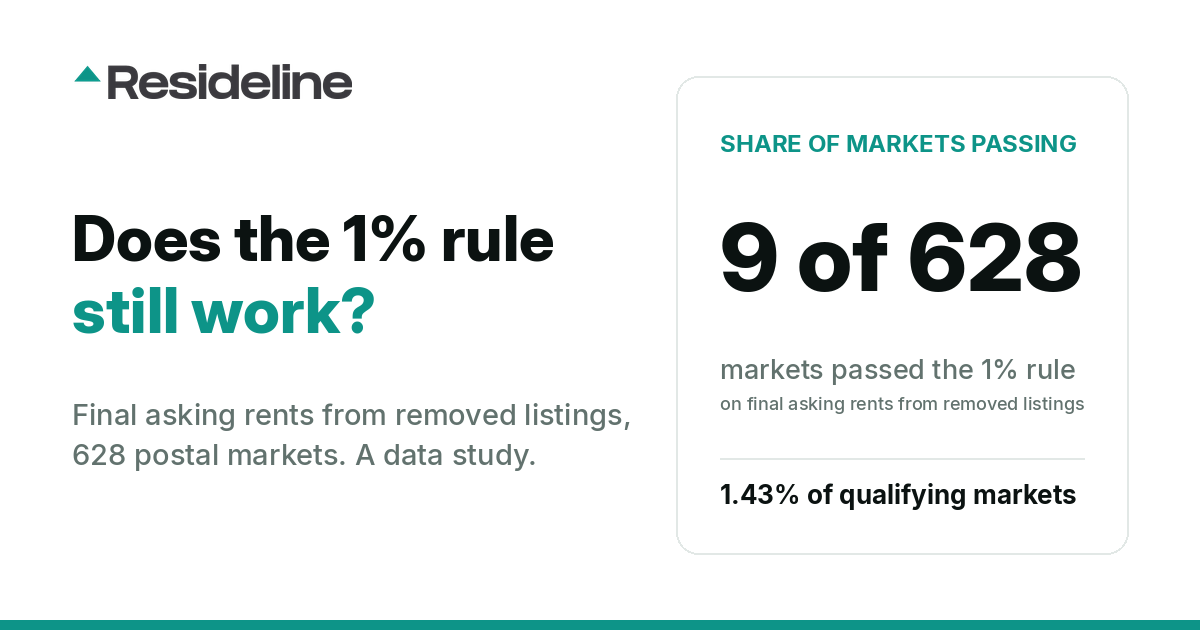
The 1 percent rule is the oldest screen in rental real estate: a property should gross monthly rent equal to at least 1 percent of its purchase price. Ask an investor forum whether it still works and you will get folklore in both directions. We tested it instead, against observed rents: confirmed lease closes where property records hold one, otherwise the final asking rent when a listing left the market. At the market level, only 9 of 628 qualifying postal markets had a median rent-to-price ratio that cleared the 1% threshold.
Across 628 cities (postal areas) with enough rental listings that left the market and sales to judge, the rule survived in exactly 9 cities. That is 1.43 percent of the 628. The median city returned a 6.53 percent gross yield, about 0.54 percent a month, roughly half of what the rule demands.
We used observed rents from removed listings. Because the earlier asking-rent study found final asking rents 4.6% above live asking rents in the median qualifying postal market, under that study's own definition, this choice does not explain the low pass count. If anything, it makes the screen slightly less strict than one built from live asking rents. The active and removed listing groups contain different properties, so this should not be interpreted as the same listing receiving a higher final rent. The gap itself is measured in our asking rent vs observed rent study on the same 12-month window across 1,726 qualifying postal markets.
What we measured
The operational test: gross annual yield of at least 12 percent, computed as 12 times the median Observed rent divided by the median sold home price. Monthly rent at 1 percent of price is exactly a 12 percent gross year.
- •Rents: the median observed rent when the listing left the market, over the trailing 12 months, drawn from roughly 3 million such listings nationally. The rent median mixes unit types (houses, condos, apartments, townhomes).
- •Prices: the median closed sale price over the same 12 months for homes (houses, condos, townhomes).
- •Gates: a city qualified with at least 150 rental listings that left the market in the last 12 months and at least 400 closed sales. Of 2,191 joined cities with both medians, 628 passed.
- •Snapshot: 2026-08-22. Everything here is a past-window number, not a projection. Figures here are the median of city medians across the 628 qualifying markets.
- •Gross means gross: unlevered, before taxes, insurance, vacancy, and management.
The nine cities where the rule survived
| # | City (postal area) | Gross yield | Median Observed rent | Median sold home price | rental listings that left the market (12 mo) | Sales (12 mo) | House share of rental observations | Cluster |
|---|---|---|---|---|---|---|---|---|
| 1 | Gary, IN | 20.00% | $1,500 | $90,000 | 285 | 989 | 88% | NW Indiana |
| 2 | Detroit, MI | 17.33% | $1,300 | $90,000 | 2,203 | 7,435 | 68% | Detroit core |
| 3 | Bedford, OH | 15.18% | $1,790 | $141,500 | 219 | 560 | 94% | Cleveland suburbs |
| 4 | Lauderhill, FL | 13.82% | $1,900 | $165,000 | 553 | 1,440 | 30% | South Florida |
| 5 | Flint, MI | 13.60% | $975 | $86,000 | 205 | 1,908 | 90% | - |
| 6 | Binghamton, NY | 12.79% | $1,900 | $178,250 | 187 | 768 | 30% | - |
| 7 | Deerfield Beach, FL | 12.77% | $2,475 | $232,500 | 598 | 1,905 | 32% | South Florida |
| 8 | Euclid, OH | 12.41% | $1,500 | $145,000 | 172 | 666 | 91% | Cleveland suburbs |
| 9 | Montgomery, AL | 12.25% | $1,450 | $142,000 | 404 | 1,798 | 80% | - |
- •Lauderhill and Binghamton are condo and apartment-majority samples. Only about 30 percent of their rental listings that left the market were houses, so their rent medians lean on condo and apartment rentals while the price median covers homes broadly.
- •Binghamton carries the biggest data flag on the list. Its observed rents ran 27 percent above its own asking-rent median, the only city on the list where the gap is that large, a pattern consistent with college-town lease selection (whole-house student rentals that reach an explicit close event through the MLS while ordinary rentals leave tracking at their observed rent). Its 12.79 percent clears the bar on the numbers we have, but its rent median is the least trustworthy of the nine.
- •Montgomery sat closest to the line. At 12.25 percent, a roughly $30 drop in the rent median or a 2.5 percent rise in the price median would have removed it. Expect that row to churn on refresh.
The geography is not random: three legacy-Midwest low-price markets (Gary, Detroit, Flint), two Cleveland suburbs, two Broward County condo markets, one upstate New York college town, and one Southern state capital.
How close everyone else got
Lower the bar and the list grows slowly. At 11 percent gross, 12 of 628 cities qualified, adding Abilene, TX (11.32 percent), Cleveland, OH (11.13 percent), and Peoria, IL (11.08 percent). At 10 percent, 23 of 628. Even a "0.85 percent rule" would have passed fewer than 4 percent of the 628 gated cities.
At the other end, the bottom five were all coastal California: Santa Monica (3.06 percent), Glendale (2.88 percent), Berkeley (2.78 percent), Newport Beach (2.52 percent), and Beverly Hills (2.42 percent). A median-priced Beverly Hills home rented at about one fifth of what the rule demands.
Is 9 a real number or an artifact of our gates?
We stress-tested it:
- •Loosen the listing floor to 100 and the qualified universe grows to 870 cities, but the 12 percent list is identical: zero new entrants. The nearest candidate, Pontiac, MI, missed both ways, with 99 rental listings that left the market and an 11.99 percent yield.
- •Tighten the floor to 200 rental listings that left the market and the count falls to 7: Euclid (172 rental listings that left the market) and Binghamton (187) exit on sample size, not on yield.
- •Stress the medians: a $25 rent haircut removes nobody; $50 removes only Montgomery; a 2 percent price bump removes nobody.
- •Widen the window to 24 months and exactly one city joins: Pontiac, MI, at 12.00 percent on that 24-month basis, with the same nine intact.
On the market count itself, 9 reads as a floor. In 92 percent of the 628 gated cities, the house-only rent median exceeded the mixed-type median, while the price side already covers homes broadly, so mixing condo and apartment rentals into the numerator mostly understates yields. A house-rent robustness check, which is upward-shifted because it divides house rents by a mixed-homes price, brackets the count between 9 and 10; changing the rent assumption alone does not establish how many matched house purchases would pass.
So does the rule still work?
As a national screen, no. It rejected 98.57 percent of the 628 gated cities, including essentially every large coastal market, and the median city sat at barely half the required yield. As a map, yes: the rule is not dead so much as geographically extinct outside a short list of deep-value markets, and the nine names above are that list.
Use it with eyes open. These are gross yields: no taxes, insurance, vacancy, management, or repairs, and in low-price markets those costs eat a bigger share of every rent dollar. That is part of why the market priced Gary at a 20.00 percent gross yield and Beverly Hills at 2.42 percent. A 12 percent gross year is a reason to underwrite a market, not a verdict on it. If the mechanics are new to you, start with our 1 percent rule explainer, then run full deal math with the rental cash flow guide.
Related studies
This article is part of a trio built on the same 628-city final-asking-rent basis: the best gross rental yields in America ranks the full top 25 beyond the 12 percent club, and rent vs buy by city maps where a median Observed rent covered the principal-and-interest payment on a median-priced home (P&I only, excluding taxes, insurance, and upkeep). The final-asking-vs-asking gap that powers all three is measured in our asking rent vs observed rent study.
Frequently Asked Questions
What is the 1 percent rule in real estate?
It is a screening rule: a rental property should gross monthly rent equal to at least 1 percent of its purchase price. That works out to a 12 percent gross annual yield, before taxes, insurance, vacancy, and management. It is a quick filter for whether a market or deal deserves a full underwrite, not an underwriting standard by itself.
Does the 1 percent rule still work in 2026?
Almost nowhere. Tested against 12 months of observed rents from rental listings that left the market and 12 months of closed home sale prices, only 9 of 628 qualified US cities (postal areas), or 1.43 percent, met the rule as of August 2026. The median city yielded 6.53 percent gross, about half of what the rule demands.
Which cities still meet the 1 percent rule?
As of our August 2026 snapshot: Gary IN, Detroit MI, Bedford OH, Lauderhill FL, Flint MI, Binghamton NY, Deerfield Beach FL, Euclid OH, and Montgomery AL. Caveats matter: Lauderhill and Binghamton rent medians come from condo and apartment-majority rental samples, and Montgomery sat barely above the 12 percent line, so it could drop off on a refresh.
Why test the rule with observed rents instead of asking rents?
Live asking rents did not systematically overstate observed rents in this study. In the earlier asking-rent study, under its own definition, the final asking rent on removed listings was 4.6% above the live asking rent in the median qualifying postal market; that comparison predates the blended measure used here and says nothing about confirmed lease closes. A 1% Rule screen built on live asking rent is therefore slightly stricter in most measured markets and may fail deals that an observed rent screen would pass. The active and removed listing groups contain different properties, so this should not be interpreted as the same listing receiving a higher final rent.

About the author
Jeffrey Batista
Jeffrey Batista is the founder of Resideline, a real estate technology company building institutional grade valuation and investment analysis tools for real estate investors.
A software engineer with more than 10 years of experience, Jeffrey has worked across full stack development, infrastructure, data engineering, machine learning, and large scale systems. He left his engineering career to build Resideline full time.
Jeffrey is also a real estate investor with nearly a decade of hands on experience buying, renovating, managing, and analyzing residential properties. His experience on both sides of the industry, as an engineer and an investor, led him to build Resideline after seeing how fragmented and outdated many of the tools available to individual investors were.
Today, he leads the development of Resideline's proprietary data infrastructure, automated valuation models, rental analytics, and investment underwriting technology.
Could the rent make this property work?
Create a free account to review rental comps, model operating costs and explore projected cash flow.
Create a free account3 free reports at signup. No card required.