Is the Housing Market Crashing? What 6.5 Million Home Sales Show (2026)
Mortgage rates are back above 7 percent and the crash headlines are everywhere. We looked at the 6.5 million closed sales we tracked over the last 17 months. Same-home house prices are still up about 1.6 percent for the year, condos are the exception, and the slowdown looks nothing like 2008.
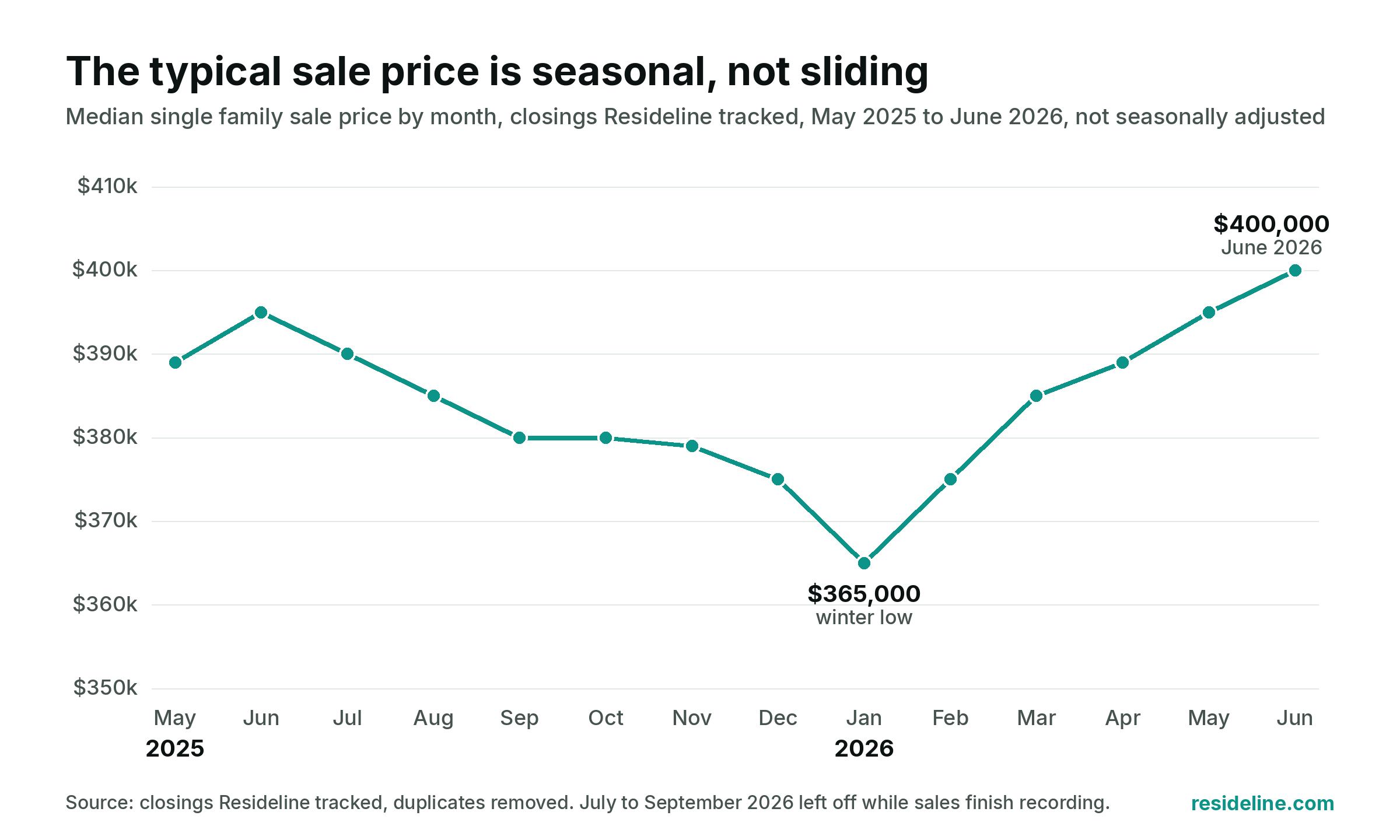
In June 2026 the typical single family home in the 6.5 million sales we tracked closed for about $400,000, up about 1 percent from $395,000 in June 2025. Not down. Up, barely, and slowing. That is the honest answer to the question in the headlines, and it is worth sitting with before reading another crash prediction.
The fear is understandable. The 30 year fixed mortgage rate reached 7.03 percent in the week of September 24, its fifth straight weekly increase and about three quarters of a point higher than a year earlier. Inventory is rising and sales are sluggish. None of that is a crash, and the closed sales show why.
Same-home prices are still rising, just slowly
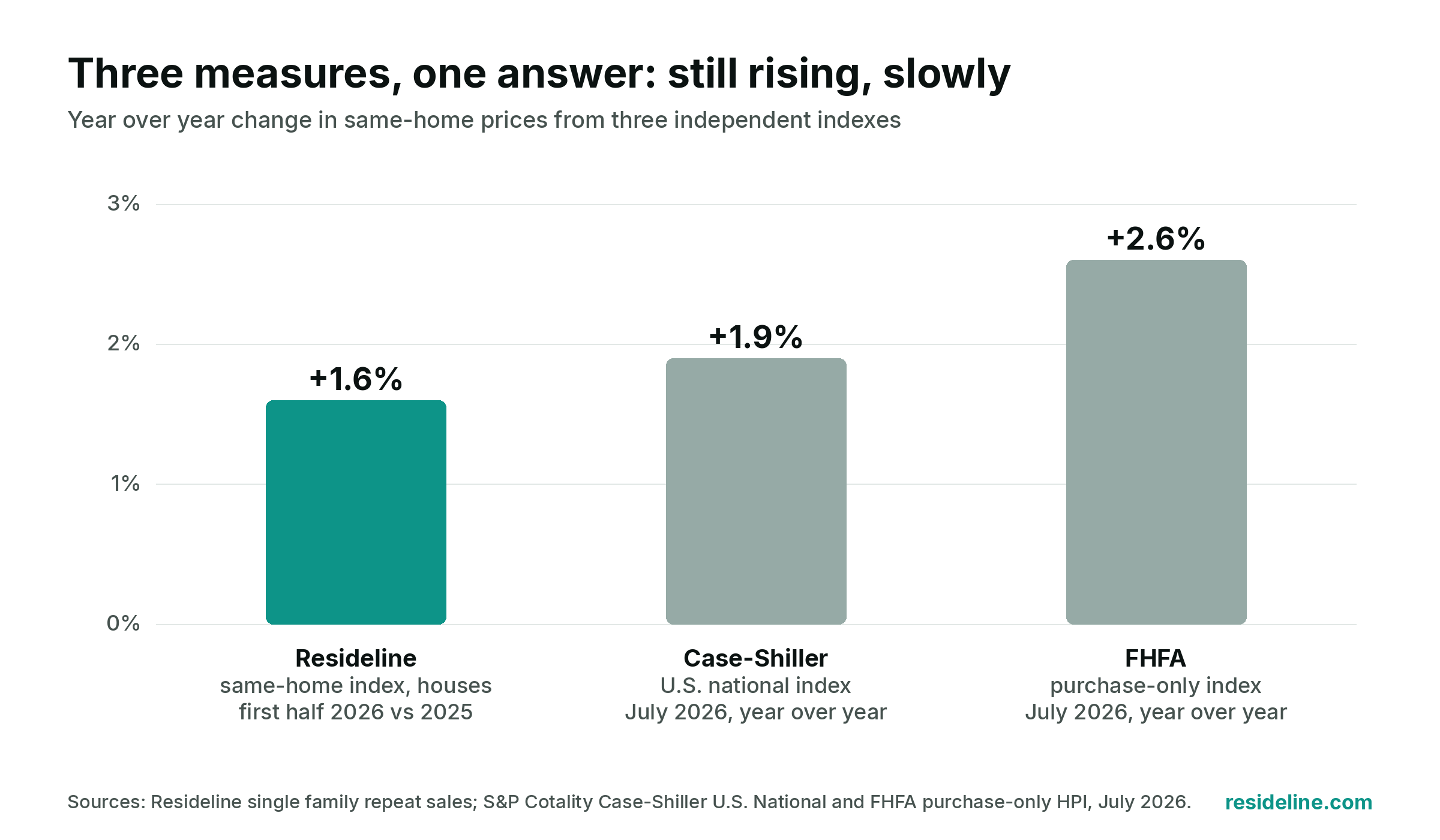
The cleanest way to measure a market is to watch the same houses sell twice and compare the two prices. That strips out the noise of which neighborhoods happened to sell in a given month, and it is the method behind the national repeat-sale indexes. Run that calculation on the single family repeat sales in our data, comparing the first half of 2026 with the first half of 2025, and same-home house prices are up about 1.6 percent nationally.
A year of gains that small is a market that has stopped running and is catching its breath. It lines up with the two most watched national gauges: the FHFA's seasonally adjusted purchase-only house price index was up 2.6 percent year over year in July 2026, and the S&P Cotality Case-Shiller national index was up 1.9 percent. Three measures, built by three different groups, all landing under 3 percent. The market has slowed a long way from 2023, when the Case-Shiller national index rose more than 5 percent, and 2024, when it rose about 4 percent.
The raw median sale price tells the same story with more noise. Among the single family closings we track, it slipped from about $395,000 in June 2025 to a winter low of $365,000 in January 2026, then climbed back to $400,000 by June 2026, a little above the summer before. That is the usual winter dip and spring recovery, not a slide.
Where prices really are falling: condos
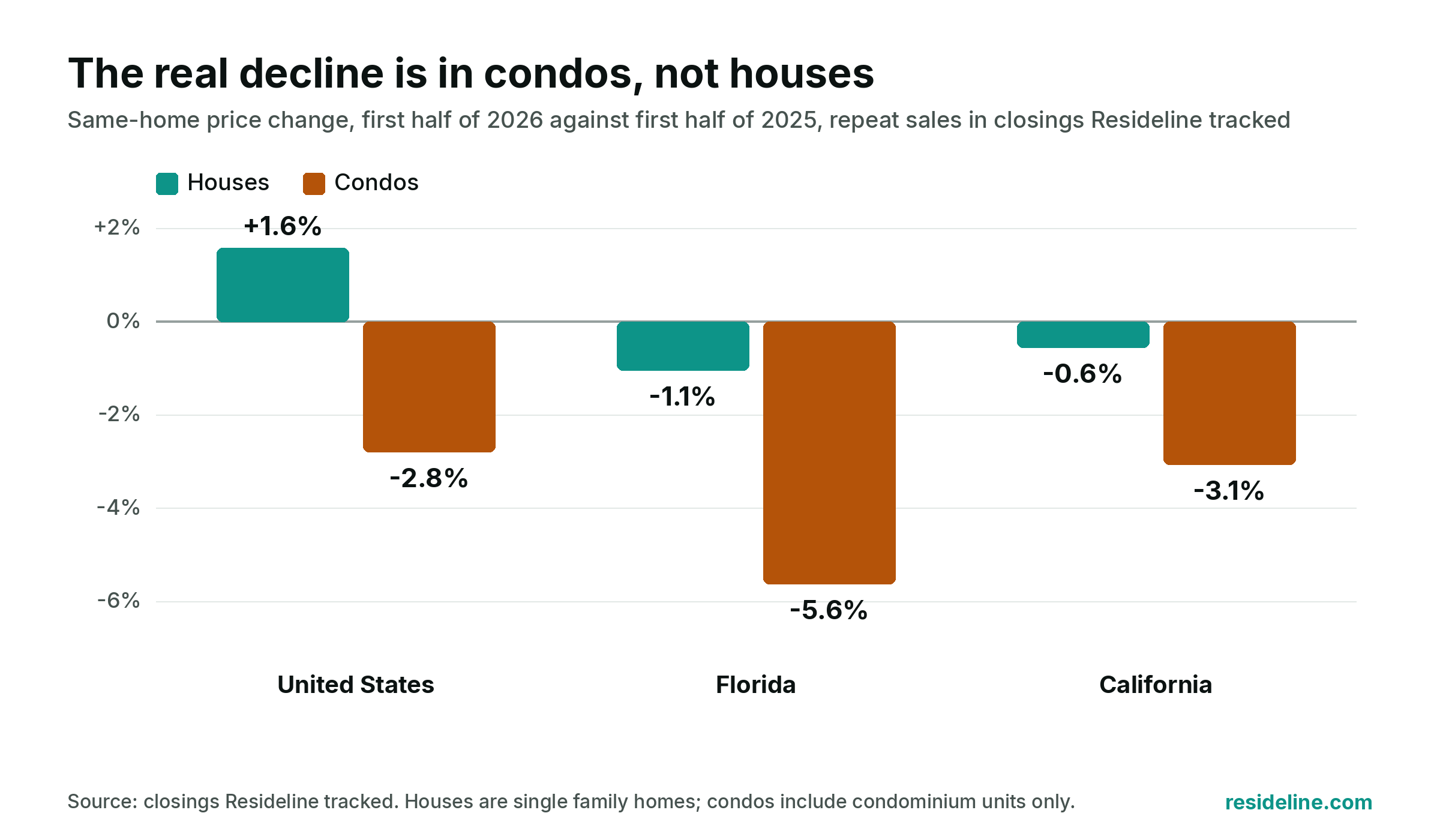
The clearest decline in our data is not in houses at all. Run the same repeat-sale calculation on condominiums and prices fell about 2.8 percent nationally over the first half of 2026. Florida condos fell about 5.6 percent and California condos about 3.1 percent, while houses in those two states were down about 1 percent and less than 1 percent. For condo owners and buyers, the decline is real and measurable. For houses, it is mostly a slowdown.
What a crash actually looks like, and this is not it
In the last housing crash, national home prices did not slow to a crawl. The Case-Shiller national index fell about 27 percent over nearly six years, from its 2006 peak to its 2012 low, and the hardest hit metros such as Phoenix and Las Vegas lost more than 30 percent in a single year. The distress fed on itself, driven by a wave of forced sales.
The 2026 market does not rhyme with that. Most homeowners with a mortgage hold a fixed rate far below today's and plenty of equity: in the FHFA's National Mortgage Database for the second quarter of 2026, the average rate on all outstanding mortgages was 4.4 percent, more than three in four loans were below 6 percent, and only about 0.3 percent of borrowers owed more than their home was worth. High rates are freezing owners in place, not forcing them out.
Rates are still going up, not down: the Federal Reserve raised its policy rate by a quarter point, to a 3.75 to 4.00 percent range, on September 16. But the recession gauges people cite are quiet. Unemployment was 4.1 percent in August. The Sahm rule, a widely watched recession signal that fires when the three month average unemployment rate rises half a point above its low of the prior year, stood at minus 0.07 in August, far below its 0.50 trigger. The gap between the 10 year Treasury yield and the 3 month bill, inverted for most of late 2022 through 2024, was a positive 1.01 percentage points on September 29. The New York Fed's yield curve model put the probability of a recession twelve months ahead, in August 2027, at about 14 percent, close to its long run average.
The slowdown is real, and it is regional
None of this means the market is healthy everywhere. Measured on houses over the first half of 2026, same-home prices fell by about 1 percent in two states, Colorado and Florida, and by less than 1 percent in two more, California and Arizona. No state we can measure fell by more than 1.1 percent. At the same time, much of the Midwest and Northeast was still climbing about 4 to 6 percent, led by New Jersey, New York, Wisconsin and Pennsylvania.
That is the real map of 2026: a flat to soft Sun Belt and West sitting next to a still-rising Midwest and Northeast. We map and rank all 25 states we can measure in where home prices are falling.
Negotiation swings with the seasons
Buyers feel the market in negotiation before they see it in price, and negotiation moves with the calendar. Among the closings in our data where the full asking-price history is on record, about 53 percent sold below their original asking price in June 2026, the same as in June 2025. In between, the share climbed to about two in three in January 2026, when the typical home took about a month to find a buyer and nearly three months to close. Winter is when buyers have the most room, which we break down in is it a buyer's market right now.
So, is it crashing?
No. It is slowing, unevenly, under the weight of 7 percent mortgages. House prices have slipped by about 1 percent or less in four states and condo prices are falling nationally, but a slowdown where the typical house still gains between 1 and 2 percent and owners keep their equity is a correction of pace, not a collapse of value. The useful move in a market like this is not to guess the top. It is to price the specific house in front of you correctly. Run any address through Resideline's free tools to see the closed comparable sales and the local trend before you make an offer or set a listing price.
How we measured this
- •Closings: 6,519,334 distinct closed sales that Resideline tracked from May 2025 through September 2026, all property types, counted once per property and closing date after removing duplicate records. Monthly medians use single family homes only and are not seasonally adjusted. Sales from July through September 2026 are still being recorded, so we treat them as provisional.
- •Same-home prices: a repeat-sale index, the method behind the Case-Shiller and FHFA indexes, built from pairs of sales of the same single family house held between one and twelve years. The change compares the average index level for January to June 2026 with January to June 2025, which keeps both periods inside the part of our data with full national coverage. It rests on 252,646 house resales in the first half of 2026. Condos are computed the same way, separately, from 29,507 condo resales. A state is reported only with at least 20,000 matched pairs overall and 2,000 resales in the first half of 2026; 25 states qualify for houses.
- •Negotiation: described in full in is it a buyer's market right now.
Sources
- •Freddie Mac Primary Mortgage Market Survey, week of September 24, 2026
- •FHFA House Price Index, July 2026 release, September 29, 2026
- •S&P Cotality Case-Shiller Home Price Indices, July 2026 release, September 29, 2026
- •S&P Cotality Case-Shiller U.S. National Home Price Index, historical series, via FRED
- •FHFA National Mortgage Database, outstanding mortgage statistics, all mortgages, second quarter 2026
- •Federal Reserve FOMC statement, September 16, 2026
- •Bureau of Labor Statistics, The Employment Situation, August 2026, September 4, 2026
- •Real-time Sahm Rule Recession Indicator, via FRED, August 2026
- •10-Year Treasury minus 3-Month Treasury spread, via FRED, September 29, 2026
- •New York Fed, yield curve as a leading indicator, probability model updated September 2026
Updated September 30, 2026.
Frequently Asked Questions
Is the housing market going to crash in 2026?
The closed sales do not point to a crash. Same-home house prices nationally were up about 1.6 percent in the first half of 2026 compared with a year earlier, and most owners with a mortgage hold rates far below today's and substantial equity: only about 0.3 percent owed more than their home was worth in the second quarter of 2026, according to FHFA. That is a slowdown under the weight of 7 percent mortgage rates, not the forced-selling spiral that drove the 2008 decline. The one clear decline is in condos, down about 2.8 percent nationally.
Are home prices going down right now?
For houses, nationally they are still edging up, about 1.6 percent. Over the first half of 2026 same-home house prices fell by about 1 percent in Colorado and Florida and by less than 1 percent in California and Arizona, while much of the Midwest and Northeast rose about 4 to 6 percent. No state we can measure fell by more than 1.1 percent. Condos are different: they fell about 2.8 percent nationally and about 5.6 percent in Florida.
Why does it feel like the market is crashing if prices are up?
Because negotiation changes before prices do, and it swings with the seasons. In January 2026 about two in three homes sold below their original asking price, and the typical home took about a month to find a buyer and nearly three months from listing to closing. By June the share selling below the original ask was back to about 53 percent, the same as a year earlier.
How is 2026 different from 2008?
In the last crash, the Case-Shiller national index fell about 27 percent over nearly six years, driven by risky loans and a wave of forced sales. In 2026 the average outstanding mortgage rate is about 4.4 percent according to FHFA, very few owners owe more than their home is worth, and house prices are still slightly positive. High rates are freezing activity, not forcing owners to sell at a loss.
Will a recession make home prices drop?
A recession could soften prices, but the standard gauges are not signaling one now: unemployment was 4.1 percent in August, the Sahm rule is far below its trigger, and the 10 year to 3 month Treasury spread is positive. Even in past recessions, home prices did not always fall: the Case-Shiller national index rose during both the 2001 and the 2020 recessions.
Should I buy a house now or wait for prices to drop?
Waiting for a national drop that the data does not show is a gamble. The better approach is local and specific: check whether your state is in the soft group or the still-rising group, and whether you are buying a house or a condo, then price the individual home against recent closed sales rather than list prices. A national number tells you almost nothing about the home you actually want.

About the author
Jeffrey Batista
Jeffrey Batista is the founder of Resideline, a real estate technology company building institutional grade valuation and investment analysis tools for real estate investors.
A software engineer with more than 10 years of experience, Jeffrey has worked across full stack development, infrastructure, data engineering, machine learning, and large scale systems. He left his engineering career to build Resideline full time.
Jeffrey is also a real estate investor with nearly a decade of hands on experience buying, renovating, managing, and analyzing residential properties. His experience on both sides of the industry, as an engineer and an investor, led him to build Resideline after seeing how fragmented and outdated many of the tools available to individual investors were.
Today, he leads the development of Resideline's proprietary data infrastructure, automated valuation models, rental analytics, and investment underwriting technology.
Check the evidence behind your property’s value.
Create a free account to inspect comps and the assumptions behind your property’s estimated value.
Create a free account3 free reports at signup. No card required.