Best Places to Buy Rental Property in Colorado (2026)
Twenty Colorado cities ranked by asking rental yield, from 7.4 percent in Commerce City to 5.4 percent in Windsor, using tracked home sales and rental listings; geographic coverage explained below.
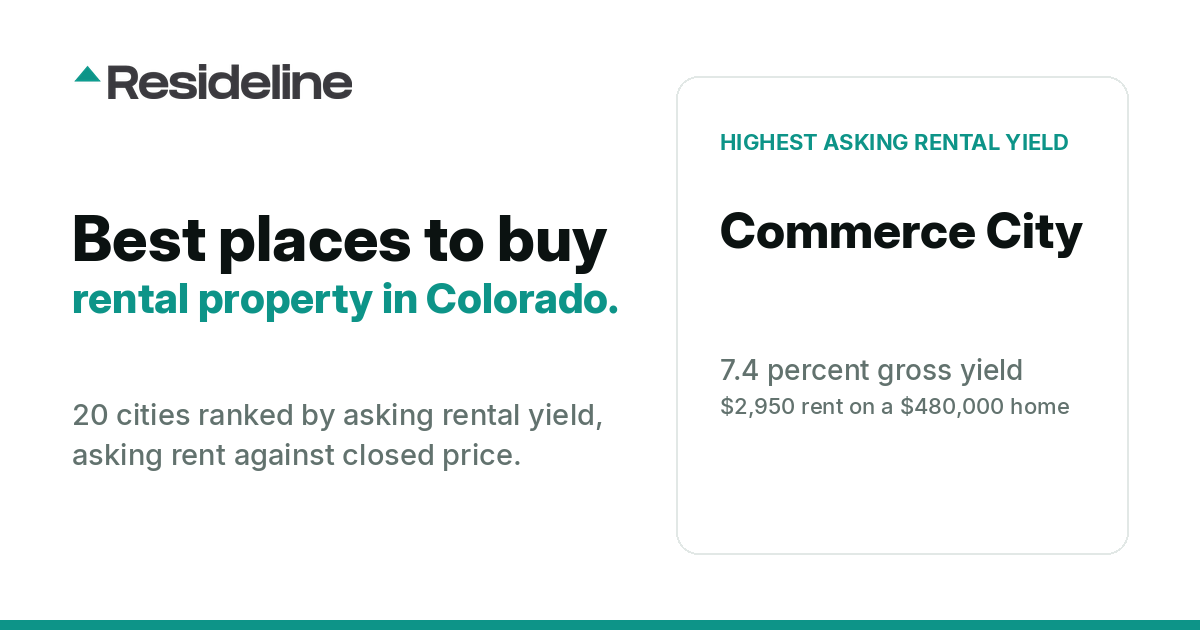
Gross asking rental yields range from 5.4 percent in Windsor to 7.4 percent in Commerce City across the 20 Colorado markets shown, a spread of 2.0 points. Compare purchase prices alongside property expenses and rental demand rather than treating the highest ratio as a recommendation. Northglenn follows at 7.3 percent, on a $445,000 median price and $2,700 in asking rent. One caution on the rent side: in Westminster houses asked a median of $2,894 while the all-type median was $2,390. For a house, compare house rents with house sale prices; substituting the house rent into a ratio whose denominator is a mixed sale median only makes the number look better, not more representative. Volume and yield part ways: Colorado Springs closes about 695 homes a month, more than any other city here, and ranks sixteenth on yield at 5.6 percent. The table shows the 20 highest-yielding markets among 47 Colorado cities meeting the coverage requirements; the yield range above describes the markets shown. A second table lists one city with enough closings to price but too few rental listings to rank.
The ranking
| # | City | Gross yield | Median asking rent | Rentals (12 mo) | Median closed price | Closings | Sales window | Confirmed-close median |
|---|---|---|---|---|---|---|---|---|
| 1 | Commerce City | 7.4% | $2,950 | 747 | $480,000 | 612 | 6 months | n/a |
| 2 | Northglenn | 7.3% | $2,700 | 340 | $445,000 | 236 | 6 months | n/a |
| 3 | Pueblo | 6.6% | $1,350 | 1,419 | $245,000 | 810 | 6 months | n/a |
| 4 | Fountain | 6.6% | $2,199 | 649 | $400,000 | 289 | 6 months | n/a |
| 5 | Aurora | 6.5% | $2,450 | 5,581 | $449,250 | 2,908 | 6 months | n/a |
| 6 | Brighton | 6.5% | $2,715 | 669 | $499,900 | 351 | 6 months | n/a |
| 7 | Johnstown | 6.4% | $2,598 | 224 | $486,824 | 345 | 6 months | n/a |
| 8 | Frederick | 6.4% | $2,890 | 131 | $544,999 | 171 | 6 months | n/a |
| 9 | Pueblo West | 6.3% | $2,100 | 138 | $399,900 | 307 | 6 months | n/a |
| 10 | Thornton | 6.3% | $2,685 | 833 | $515,000 | 1,030 | 6 months | n/a |
| 11 | Firestone | 6.1% | $2,886 | 57 | $567,500 | 150 | 6 months | n/a |
| 12 | Berthoud | 6.0% | $2,795 | 181 | $557,500 | 198 | 6 months | n/a |
| 13 | Peyton | 5.8% | $2,595 | 313 | $533,995 | 396 | 6 months | n/a |
| 14 | Castle Rock | 5.7% | $3,085 | 1,078 | $645,000 | 839 | 6 months | n/a |
| 15 | Parker | 5.6% | $2,995 | 1,167 | $640,000 | 550 | 6 months | n/a |
| 16 | Colorado Springs | 5.6% | $2,100 | 11,165 | $449,999 | 4,168 | 6 months | n/a |
| 17 | Westminster | 5.6% | $2,390 | 917 | $516,000 | 669 | 6 months | n/a |
| 18 | Monument | 5.4% | $2,895 | 211 | $639,000 | 174 | 6 months | n/a |
| 19 | Centennial | 5.4% | $2,924 | 647 | $650,000 | 835 | 6 months | n/a |
| 20 | Windsor | 5.4% | $2,650 | 423 | $589,975 | 538 | 6 months | n/a |
City by city
1. Commerce City, 7.4 percent gross
Commerce City ranks first on yield but only seventh on entry price: the $2,950 median asking rent is doing the work, not a cheap purchase. The numbers: $480,000 median closed price across 612 closings, $2,950 median asking rent across 747 listings, 7.4 percent gross. Houses there closed at about $212 per square foot. The Commerce City market page carries the monthly figures.
2. Northglenn, 7.3 percent gross
Northglenn moves fast, 10 days from listing to contract at the median, which matters more than its 7.3 percent yield if you cannot close quickly. At $445,000 to buy and $2,700 a month to rent, Northglenn yields 7.3 percent gross on 236 tracked closings. See the Northglenn page for the property mix and the price band.
3. Pueblo, 6.6 percent gross
The numbers: $245,000 median closed price across 810 closings, $1,350 median asking rent across 1,419 listings, 6.6 percent gross. Houses there closed at about $149 per square foot. See the Pueblo page for the property mix and the price band.
4. Fountain, 6.6 percent gross
The numbers: $400,000 median closed price across 289 closings, $2,199 median asking rent across 649 listings, 6.6 percent gross. Houses there closed at about $194 per square foot. Full detail is on the Fountain market page.
5. Aurora, 6.5 percent gross
The numbers: $449,250 median closed price across 2,908 closings, $2,450 median asking rent across 5,581 listings, 6.5 percent gross. Full detail is on the Aurora market page.
6. Brighton, 6.5 percent gross
The numbers: $499,900 median closed price across 351 closings, $2,715 median asking rent across 669 listings, 6.5 percent gross. Houses there closed at about $216 per square foot. The Brighton market page carries the monthly figures.
7. Johnstown, 6.4 percent gross
Homes in Johnstown closed at a median of $486,824 over the last six months and the median asking rent in the last twelve months was $2,598, a gross yield of 6.4 percent. Houses there closed at about $211 per square foot. Full detail is on the Johnstown market page.
8. Frederick, 6.4 percent gross
Rent is what puts Frederick eighth here; on price alone it would sit thirteenth of 20. At $544,999 to buy and $2,890 a month to rent, Frederick yields 6.4 percent gross on 171 tracked closings. Houses there closed at about $226 per square foot. See the Frederick page for the property mix and the price band.
9. Pueblo West, 6.3 percent gross
A low entry price does not carry Pueblo West far: it is second cheapest on this list and ninth on yield, with rent of $2,100 against a $399,900 median price. The numbers: $399,900 median closed price across 307 closings, $2,100 median asking rent across 138 listings, 6.3 percent gross. Houses there closed at about $161 per square foot. Full detail is on the Pueblo West market page.
10. Thornton, 6.3 percent gross
The numbers: $515,000 median closed price across 1,030 closings, $2,685 median asking rent across 833 listings, 6.3 percent gross. Houses there closed at about $224 per square foot. See the Thornton page for the property mix and the price band.
11. Firestone, 6.1 percent gross
Rent is what puts Firestone eleventh here; on price alone it would sit fifteenth of 20. The numbers: $567,500 median closed price across 150 closings, $2,886 median asking rent across 57 listings, 6.1 percent gross. The Firestone market page carries the monthly figures.
12. Berthoud, 6.0 percent gross
Homes in Berthoud closed at a median of $557,500 over the last six months and the median asking rent in the last twelve months was $2,795, a gross yield of 6.0 percent. Full detail is on the Berthoud market page.
13. Peyton, 5.8 percent gross
The numbers: $533,995 median closed price across 396 closings, $2,595 median asking rent across 313 listings, 5.8 percent gross. See the Peyton page for the property mix and the price band.
14. Castle Rock, 5.7 percent gross
Castle Rock ranks fourteenth on yield but only nineteenth on entry price: the $3,085 median asking rent is doing the work, not a cheap purchase. Homes in Castle Rock closed at a median of $645,000 over the last six months and the median asking rent in the last twelve months was $3,085, a gross yield of 5.7 percent. See the Castle Rock page for the property mix and the price band.
15. Parker, 5.6 percent gross
Homes in Parker closed at a median of $640,000 over the last six months and the median asking rent in the last twelve months was $2,995, a gross yield of 5.6 percent. Houses there closed at about $211 per square foot. See the Parker page for the property mix and the price band.
16. Colorado Springs, 5.6 percent gross
Colorado Springs is cheaper than its yield rank suggests: sixth on price, sixteenth on yield, because a $449,999 home there rents for only $2,100. At $449,999 to buy and $2,100 a month to rent, Colorado Springs yields 5.6 percent gross on 4,168 tracked closings. The Colorado Springs market page carries the monthly figures.
17. Westminster, 5.6 percent gross
Westminster is cheaper than its yield rank suggests: eleventh on price, seventeenth on yield, because a $516,000 home there rents for only $2,390. The numbers: $516,000 median closed price across 669 closings, $2,390 median asking rent across 917 listings, 5.6 percent gross. Full detail is on the Westminster market page.
18. Monument, 5.4 percent gross
Homes in Monument closed at a median of $639,000 over the last six months and the median asking rent in the last twelve months was $2,895, a gross yield of 5.4 percent. Houses there closed at about $222 per square foot. Full detail is on the Monument market page.
19. Centennial, 5.4 percent gross
Homes in Centennial closed at a median of $650,000 over the last six months and the median asking rent in the last twelve months was $2,924, a gross yield of 5.4 percent. Houses there closed at about $251 per square foot. See the Centennial page for the property mix and the price band.
20. Windsor, 5.4 percent gross
A low entry price does not carry Windsor far: it is sixteenth cheapest on this list and twentieth on yield, with rent of $2,650 against a $589,975 median price. The numbers: $589,975 median closed price across 538 closings, $2,650 median asking rent across 423 listings, 5.4 percent gross. Houses there closed at about $216 per square foot. Full detail is on the Windsor market page.
Priced, but too few rentals to rank
These cities cleared 100 tracked closings but fewer than 50 rental listings carried their name in the last twelve months, so no yield is printed for them.
| City | Median closed price | Closings | Rentals (12 mo) |
|---|---|---|---|
| Severance | $499,950 | 161 | 38 |
How this ranking is built
- •Cities: every Colorado city where Resideline tracked at least 100 closings inside the municipal boundary in its reporting window (six or twelve months) and at least 50 rental listings under the city's name since October 3, 2025: 47 cities qualify and the table shows the 20 highest-yielding.
- •Prices: the median price homes closed at inside the city limits, from Resideline's tracked closings; the state comparison uses the statewide median of $544,000 across 51,076 closings.
- •Rents: the median advertised rent on rental listings Resideline tracked in the last twelve months, all property types, measured on the listings that carry the city's name (a postal footprint, wider than the city line in some places).
- •Confirmed-close medians: Observed rent blends two kinds of record: confirmed lease closes extracted from property records, and the final asking rent on listings that left Resideline tracking without a recorded close. Where a city has at least 30 confirmed closes in the window, their median is printed beside the asking figure; in the last twelve months about a quarter of Resideline's close episodes are confirmed closes. The asking and confirmed-close samples are separate, not paired, so a difference between their medians is not a measured gap on the same listings.
- •What is missing: taxes, insurance, vacancy, management and repairs, which turn a gross yield into a net one, and the unit mix, which differs between what sells and what rents.
Sources and related pages
- •Resideline tracked closings inside city limits (window per city, updated October 4, 2026) and rental listings since October 3, 2025; confirmed lease closes extracted from property records.
- •More Colorado rankings: Cheapest cities to buy a house in Colorado ranks the same kind of list with each city's price per square foot for houses, realized appreciation and days to contract beside the median, and Cap Rate by City ranks the Colorado cities Resideline tracks by gross rental yield. The Colorado housing market hub carries the statewide figures and the largest Colorado markets by closings.
- •Asking rent vs observed rent compares live asking rents with final asking rents under that study's own definition; it says nothing about confirmed lease closes.
Prepared with Resideline's research pipeline and reviewed by Jeffrey Batista, Resideline's founder.
Frequently Asked Questions
Which Colorado city has the highest asking rental yield?
Commerce City, at 7.4 percent: a median asking rent of $2,950 against a median closed price of $480,000, on 612 closings and 747 rental listings. Rents and sales are separate samples, so the ratio is a screen rather than a guaranteed return on a given home.
Does the cheapest Colorado city also have the highest asking rental yield?
No. Pueblo is the cheapest at $245,000 but ranks third on the ratio; Commerce City leads because its asking rent is high relative to its price. The ratio is a screen, not a matched property yield.
Are these asking rents or confirmed lease closes?
The yield column uses the median asking rent on tracked listings. Where a city has at least 30 confirmed lease closes in the window, the table also shows their median, so you can see how far asking sits from closes there. Resideline's close records blend confirmed closes with final asking rents on listings that left tracking, and about a quarter of the last twelve months are confirmed closes.
How many Colorado cities qualify?
Forty-seven, each with at least 100 tracked closings inside the city limits and 50 rental listings in the last twelve months; the table shows the 20 highest-yielding, plus one more that clears the closings bar but not the rental one.

About the author
Jeffrey Batista
Jeffrey Batista is the founder of Resideline, a real estate technology company building institutional grade valuation and investment analysis tools for real estate investors.
A software engineer with more than 10 years of experience, Jeffrey has worked across full stack development, infrastructure, data engineering, machine learning, and large scale systems. He left his engineering career to build Resideline full time.
Jeffrey is also a real estate investor with nearly a decade of hands on experience buying, renovating, managing, and analyzing residential properties. His experience on both sides of the industry, as an engineer and an investor, led him to build Resideline after seeing how fragmented and outdated many of the tools available to individual investors were.
Today, he leads the development of Resideline's proprietary data infrastructure, automated valuation models, rental analytics, and investment underwriting technology.
Could your next Colorado rental work?
Create a free account to review rental comps, model operating costs and explore projected cash flow.
Create a free account3 free reports at signup. No card required.