What a Swimming Pool Actually Adds: $45,000, From 135,239 Matched Sales
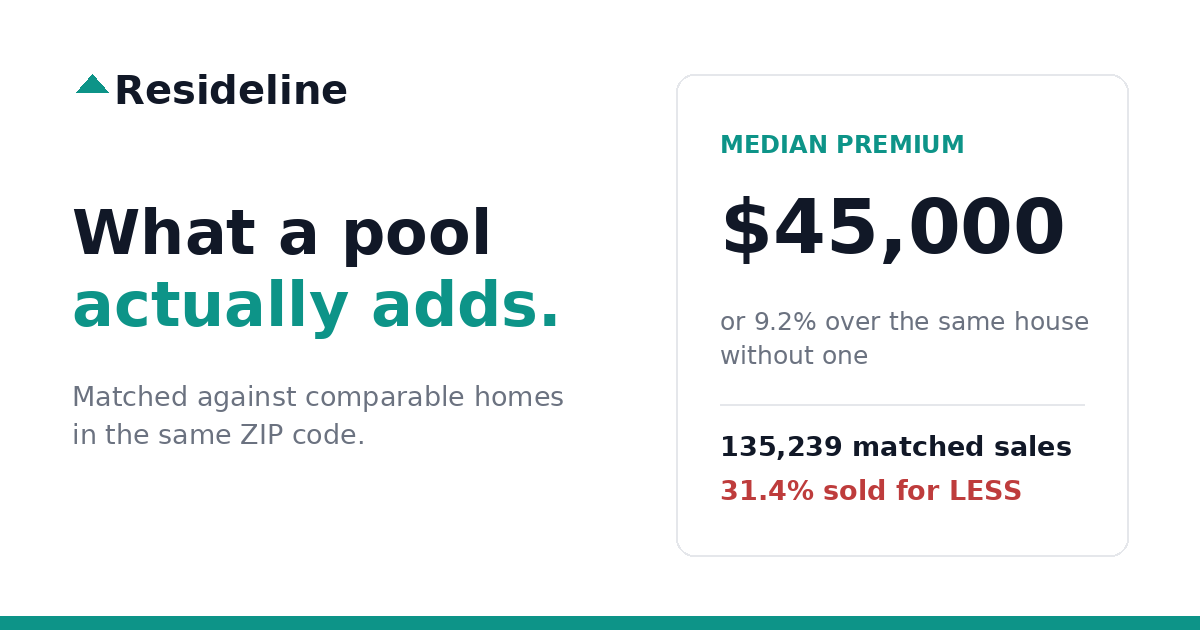
The most repeated number in this category, that a pool adds about 7 percent, traces to a single 1981 appraisal paper on suburban Baltimore. We measured it against closed sales instead: same ZIP code, same bedroom and bathroom count, within 10 percent on square footage. The median private pool added $45,000. In roughly one matched sale in three, it added nothing at all.
Ask what a swimming pool adds to a house and you will get a number back within seconds. It is usually 7 percent.
That number has a source. It is a 1981 paper in The Appraisal Journal by Benedict J. Frederick, studying single-family homes in suburban Baltimore. Forty-five years later it is still circulating as a national statistic, and the chain of citation has become a closed loop: Redfin's blog cites Curbio, Curbio cites Investopedia, and none of them cite Frederick. Along the way, Frederick's own caveat was deleted. He reported that 40 percent of the market considered a pool a liability, and that a pool's market value ran 50 to 75 percent of what it cost to build. Neither of those survives in the modern retellings.
The other widely quoted figures are not measurements either. The National Association of REALTORS® puts pool cost recovery at 56 percent, from a survey in which 1,891 agents were asked to estimate the value of a hypothetical 18 by 36 foot gunite pool on a hypothetical 2,500 square foot house. Zero transactions were involved. Realtor.com published a 54 percent "pool premium" in 2025 by comparing median list prices, where the pool homes were also 32.4 percent larger than the homes they were compared to.
So we measured it.
How we measured it
We took 1,306,235 closed sales of single-family houses over the last twelve months and split them into houses whose listing described a private pool and houses whose listing did not. Then, and this is the part that matters, we compared them only against each other inside the same ZIP code, matched on identical bedroom count, bathroom count within half a bath, and living area within 10 percent.
That constraint is the whole design. Pools are not scattered at random. They sit on bigger lots, on bigger houses, in warmer and wealthier neighborhoods. A raw comparison of pool homes to non-pool homes mostly measures those things. Matching inside one ZIP, between houses of near-identical size and room count, strips out the neighborhood and the house and leaves the pool.
180,863 of the sales described a private pool. 135,239 of those found at least two genuine matches nearby and form the study.
The answer
The median matched pool home sold for $45,000 more than the comparable houses without one, a premium of 9.2 percent.
We ran a second, completely different estimator as a check: a regression of log sale price on log square footage, bedrooms, bathrooms and a pool indicator, with a fixed effect for every ZIP code. It uses all 1,238,104 rows rather than only the matchable ones, so it catches bias that matching itself could introduce. It returns +11.8 percent.
Two methods with different failure modes landing at 9.2 and 11.8 percent is the actual evidence here. The honest reading is that a pool is worth somewhere around a tenth of a house, not a precise 9.2.
The premium shrinks as a percentage and grows in dollars
This is the finding that the single national number hides. Sorting ZIP codes by their own price level:
| ZIP price level | ZIPs | Median pool premium | As a share of price |
|---|---|---|---|
| $200,000 to $350,000 | 494 | $33,000 | 11.0% |
| $350,000 to $500,000 | 920 | $35,175 | 8.7% |
| $500,000 to $750,000 | 665 | $45,000 | 8.1% |
| $750,000 to $1,200,000 | 361 | $50,500 | 5.9% |
| Above $1,200,000 | 240 | $76,625 | 4.6% |
Where a pool pays
By state, ranked by the dollar premium:
| State | Median premium | As % | Matched ZIPs | Pool sales |
|---|---|---|---|---|
| Utah | $70,752 | 12.9% | 6 | 505 |
| Florida | $53,745 | 12.5% | 728 | 71,144 |
| Texas | $46,250 | 11.0% | 505 | 18,739 |
| California | $41,875 | 5.2% | 790 | 31,506 |
| Tennessee | $40,687 | 8.4% | 176 | 4,726 |
| South Carolina | $39,550 | 9.5% | 135 | 5,899 |
| Nevada | $36,686 | 8.2% | 74 | 4,660 |
| Louisiana | $36,107 | 11.1% | 90 | 2,508 |
| Arizona | $36,000 | 7.6% | 197 | 17,408 |
| Georgia | $28,450 | 6.9% | 266 | 9,096 |
| North Carolina | $22,754 | 5.5% | 244 | 7,511 |
| Kansas | $16,050 | 3.8% | 38 | 738 |
| Colorado | $5,000 | 0.8% | 95 | 1,320 |
At city level, southwest Florida dominates, and the reason is structural. In Cape Coral, Florida, the median matched pool home sold for $100,750 more, a premium of 27.5 percent across 2,468 matched sales. Port Charlotte returns 23.9 percent, Bradenton 18.9 percent, Punta Gorda 17.8 percent. These are canal and retirement markets where a pool is close to standard equipment and a house without one is the exception.
Compare that to Scottsdale, Arizona, where the dollar premium is a healthy $70,000 but the percentage is only 5.6 percent, because the houses are expensive to begin with and nearly everyone has a pool.
Where a pool costs you
31.4 percent of matched pool homes sold for less than the comparable houses without one. Not less than they hoped. Less than the actual houses next door of the same size and room count that had no pool.
At ZIP level, 335 of 2,682 qualifying ZIP codes, one in eight, showed a negative median premium. The pattern is concentrated in expensive coastal markets where lot space is the scarce good and a pool consumes it. In Del Mar, California, matched pool homes ran 18.4 percent behind. In La Jolla, 15.7 percent behind across 34 matched sales. In Sunnyvale, 26.1 percent.
Frederick found the same thing in Baltimore in 1981, and wrote it down. It is the part of his paper that stopped being quoted.
Set against what a pool costs
NAR's contractor panel puts an in-ground pool at roughly $90,000 to build. Our national median premium of $45,000 is almost exactly half of that.
Which puts our 2026 closed-sale measurement inside the range Frederick reported from 1981 field appraisals: a pool's market value is 50 to 75 percent of its replacement cost. The percentage that got laundered into a national rule of thumb was the wrong number to keep. The cost-recovery ratio underneath it has held up for forty-five years.
What this means in practice
If you are selling a house with a pool, expect to recover roughly half of what the pool cost, and expect that number to be a smaller share of your sale price the more expensive your house is. In southwest Florida you will do considerably better. On an expensive coastal lot you may do worse than the neighbors without one.
If you are buying, a pool is not a free upgrade priced into the market at cost. You are paying a real premium, and in one matched sale in three that premium reverses at resale.
If you are valuing a property, the national 7 percent figure is not a usable input. The premium ranges from 0.8 percent in Colorado to 27.5 percent in Cape Coral, and it varies more by price level within a state than it does between most states.
Method and limits
We are publishing the limits because they change how much weight the number carries.
Pools are identified from listing text, not a structured field. Our corpus has no reliable pool flag, so a private pool is detected from language like "screened pool" or "pool and spa". We deliberately excluded "room for a pool" and community or HOA pool language, and we dropped 598,183 sales whose listings were too thin or too ambiguous to classify rather than guessing at them. As a sanity check, the detector finds private-pool language on 27 percent of detailed Florida listings, 17 percent in Arizona, 10 percent in Texas and 3 percent in Michigan, which is the ordering real pool ownership takes.
Silence is treated as absence. A control house is one whose listing runs at least 300 characters and never mentions a pool. A pool is a headline feature, so a thousand-character listing that never mentions one almost certainly has none, but some pools will be missed. That error makes our premium a slight underestimate, since a few pool homes sit in the control group.
We do not control for waterfront, lot size or pool condition. This matters most in Cape Coral and Port Charlotte, where pool homes are also more likely to be on a canal. Some of that 27.5 percent is waterfront, not water.
Houses only. Condominiums and townhouses are excluded, because their pools are shared amenities and including them would measure HOA features rather than private pools.
Method: matched pairs within ZIP code on bedrooms, bathrooms and living area, twelve months of closed sales, cross-checked against a ZIP fixed-effects regression.
Frequently Asked Questions
How much does a swimming pool add to home value?
Across 135,239 matched closed sales, the median private pool added $45,000, a premium of 9.2 percent over comparable houses in the same ZIP code with the same bedroom and bathroom count and within 10 percent on square footage. A separate ZIP fixed-effects regression on 1,238,104 sales returns 11.8 percent. The honest reading is roughly a tenth of a house, not a precise figure.
Where does the '7 percent' pool value figure come from?
A 1981 paper by Benedict J. Frederick in The Appraisal Journal, studying suburban Baltimore. It is still quoted as a national statistic in 2026, largely through publishers citing each other rather than the original. Frederick also reported that 40 percent of the market considered a pool a liability and that a pool was worth 50 to 75 percent of its replacement cost, neither of which survives in the modern retellings.
Does a pool ever lower a home's value?
Yes, and more often than the conventional advice suggests. 31.4 percent of matched pool homes sold for less than comparable houses without a pool, and one in eight ZIP codes showed a negative median premium. It concentrates in expensive coastal markets where lot space is scarce: Del Mar CA ran 18.4 percent behind and Sunnyvale CA 26.1 percent behind.
Which cities have the highest pool premium?
Southwest Florida leads. Cape Coral, FL returns a median of $100,750, or 27.5 percent, across 2,468 matched sales. Port Charlotte returns 23.9 percent, Bradenton 18.9 percent and Punta Gorda 17.8 percent. By state, Utah leads on dollars at $70,752 and Colorado is lowest at $5,000, or 0.8 percent, where the swimming season is too short for buyers to pay for one.
Do you recoup the cost of installing a pool?
Roughly half. Against the industry figure of about $90,000 to build an in-ground pool, our measured national median premium of $45,000 is almost exactly 50 percent cost recovery. That sits inside the 50 to 75 percent range reported from field appraisals in 1981, so the cost-recovery ratio has held up better than the percentage figure everyone quotes.

About the author
Jeffrey Batista
Jeffrey Batista is the founder of Resideline, a real estate technology company building institutional grade valuation and investment analysis tools for real estate investors.
A software engineer with more than 10 years of experience, Jeffrey has worked across full stack development, infrastructure, data engineering, machine learning, and large scale systems. He left his engineering career to build Resideline full time.
Jeffrey is also a real estate investor with nearly a decade of hands on experience buying, renovating, managing, and analyzing residential properties. His experience on both sides of the industry, as an engineer and an investor, led him to build Resideline after seeing how fragmented and outdated many of the tools available to individual investors were.
Today, he leads the development of Resideline's proprietary data infrastructure, automated valuation models, rental analytics, and investment underwriting technology.
How does your property compare with nearby sales?
Create a free account to inspect comparable properties and assess the assumptions behind the estimate.
Create a free account3 free reports at signup. No card required.