Back to Blog
Market Watch
July 30, 2026
7 min read

Montana Housing Market 2026: Prices, Inventory & Trends

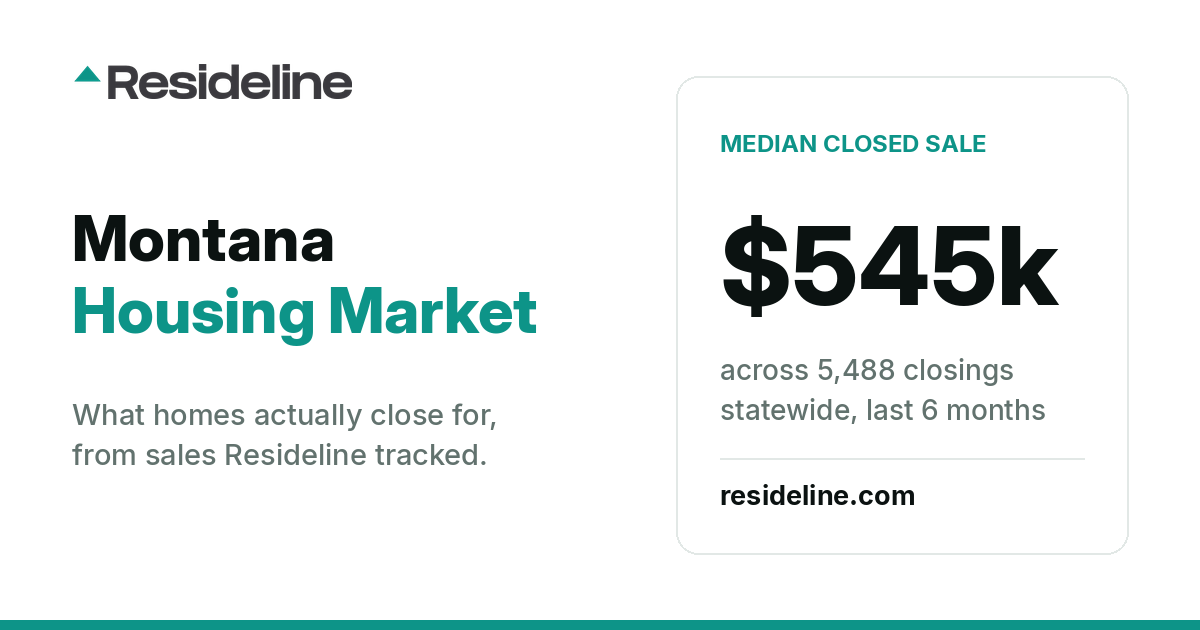
Montana's median sold price is $540,000 across 4,770 closings in six months, while median asks run $209,650 higher. Here is what the valley-by-valley split really shows.

Resideline Team
Montana Housing Market 2026: Prices, Inventory & Trends

The median home in Montana closed at $540,000 over the last six months, across 4,770 closings statewide. That is a higher median than Pennsylvania, South Carolina, Nevada, or Nebraska, in a state with a fraction of their population and the smallest transaction pool in this data set. Montana is now a genuinely expensive housing market, and the numbers behind that deserve a close look. That gap has a structural explanation. Meanwhile the 4,770 closings include the full volume of Great Falls at $352,750 and Butte at $315,000, which clear without accumulating. The 39 percent spread is a portrait of a bifurcated state, not a discount schedule. The practical consequence: browsing Montana listings will convince you the state costs $750,000. The transaction record says $540,000, and two of its highest-volume cities close under $400,000. A $1,179,000 Whitefish property and a $315,000 Butte house are not on the same timeline. One data note worth flagging honestly: Billings shows 130 closings in this six-month window, lower than you would expect for Montana's largest city by population, and far below Missoula's 635. That pattern usually indicates partial listing coverage in the underlying feed rather than a frozen market. If you are evaluating Billings, verify local activity directly rather than treating this count as complete. Do not anchor your budget to Montana's median list of $749,650. Anchor it to what has actually closed in the specific valley you are buying in. For sellers, a 0.35 ratio is the softest condition in this batch outside Nevada. In this environment the listings that move are the correctly priced ones, and a wide asking-price gap statewide means buyers have learned to discount asks. For investors, Montana presents the hardest structural problem in this batch: there is almost no affordable tier with real volume, and only ten cities in the entire state recorded 100 or more closings in six months.

The Biggest Markets in Montana

CityClosings (6 mo)Median Sold Price
Missoula635$549,000
Bozeman605$723,990
Great Falls571$352,750
Kalispell482$575,000
Helena410$475,000
Belgrade236$554,887
Butte205$315,000
Whitefish169$1,179,000
Billings130$391,200
Hamilton121$499,070
Stevensville98$637,750
Columbia Falls96$672,000
Montana's volume is spread across valleys rather than concentrated in one metro. The four largest markets, Missoula at 635 closings, Bozeman at 605, Great Falls at 571, and Kalispell at 482, together account for 2,293 transactions, about 48 percent of the state. The price divergence between them is the story. Great Falls at $352,750 and Bozeman at $723,990 are both top-four volume markets, and Bozeman costs $371,240 more. Butte at $315,000 is cheaper still, on 205 closings. The Gallatin Valley, Bozeman at 605 closings plus Belgrade at 236, produces 841 transactions at medians of $723,990 and $554,887. The Flathead Valley, Kalispell at 482 plus Whitefish at 169 plus Columbia Falls at 96, produces 747 transactions at $575,000, $1,179,000, and $672,000. Those two valleys are the amenity-driven side of Montana, and together they represent about 33 percent of state volume at prices well above the state median. The Bitterroot, Hamilton at 121 and Stevensville at 98, follows the same amenity pattern at $499,070 and $637,750. Against that, Great Falls, Butte, Helena at $475,000, and Billings at $391,200 represent the working-economy side of the state.

Where the Affordable Markets Are

Only ten Montana cities recorded 100 or more closings in six months, the shortest list in this batch, and it is worth being blunt about what it contains. The cheapest entry is Butte at $315,000, roughly 58 percent of the statewide median. The most expensive is Whitefish at $1,179,000, about 218 percent of the state median. Five of those ten close below the state median: Butte at $315,000, Great Falls at $352,750, Billings at $391,200, Helena at $475,000, and Hamilton at $499,070. The other five, Missoula at $549,000, Belgrade at $554,887, Kalispell at $575,000, Bozeman at $723,990, and Whitefish at $1,179,000, close above it and appear only because Montana does not have enough cities with real volume for the list to fill with cheaper ones. Geographically the below-median markets are the state's traditional working cities: Butte in the southwest, Great Falls on the Missouri, Helena as the state capital, Billings in the south-central, and Hamilton in the Bitterroot. The full ranking with closing volume is in our guide to the best places to buy rental property in Montana.

How to Analyze a Specific Montana Property

In a state where the median list and median close differ by $209,650 and where valley-to-valley price differences exceed $800,000, the statewide number is close to useless as an underwriting input. Start with the local baseline through our market pages, pulling data for the actual city and ZIP. A figure that blends Whitefish with Butte is not a comparison set for anything. Then value the property. Resideline estimates are frozen at the moment of listing and later graded against the real closing price, with results published on a public accuracy dashboard rather than asserted in marketing copy. The comps behind each estimate are visible and adjustable, which matters more in Montana than almost anywhere because acreage, view, water frontage, and proximity to public land can separate two structurally identical homes by hundreds of thousands of dollars. Condition is estimated from the listing photos, so a property needing work is not valued like a finished one. Live valuation coverage currently spans 31 states. Three Montana specifics belong in every model. First, well and septic systems are common outside city limits, and both inspection scope and replacement cost differ from municipal service. Second, wildfire exposure affects insurance availability and cost, and it should be quoted before you model, not after. Third, in the amenity valleys, short-term rental regulation varies by jurisdiction and changes, so any assumption about how a property may be used needs to be checked against current local rules rather than assumed. For a renovation purchase, the ARV calculator separates after-repair value from as-is value. For a hold, the rental property calculator requires real rent, taxes, insurance, and vacancy inputs rather than estimates. To compare properties, the deal analyzer puts purchase, rehab, financing, and exit in one view, and all of the free calculators work without a signup. With only 4,770 closings statewide over six months, Montana gives you less data to work with than any other state here. That makes careful, manual comparable review more important, not less.

Frequently Asked Questions

Which Montana city has the most home sales?

Missoula leads with 635 closings in six months at a $549,000 median, narrowly ahead of Bozeman with 605 at $723,990 and Great Falls with 571 at $352,750. Note that Billings, the state's largest city by population, records only 130 closings in this data, which likely reflects partial listing coverage rather than a stalled market.

Where is Montana still affordable?

Among cities with at least 100 closings, Butte is cheapest at $315,000, followed by Great Falls at $352,750, Billings at $391,200, Helena at $475,000, and Hamilton at $499,070. Those five are the only Montana markets in this data closing below the $540,000 statewide median.

Ready to Start Investing Smarter?

Join 2,000+ investors using Resideline.
Start free with 3 reports a month.

Start Free

Keep reading

All articles