The Real Estate Data API for AI Apps: ARV, Comps, and Rent
AI proptech apps fail at the data layer, not the model. Here is the developer view of the Resideline real estate data API: endpoints, credit costs, REST vs MCP, and accuracy you can verify.
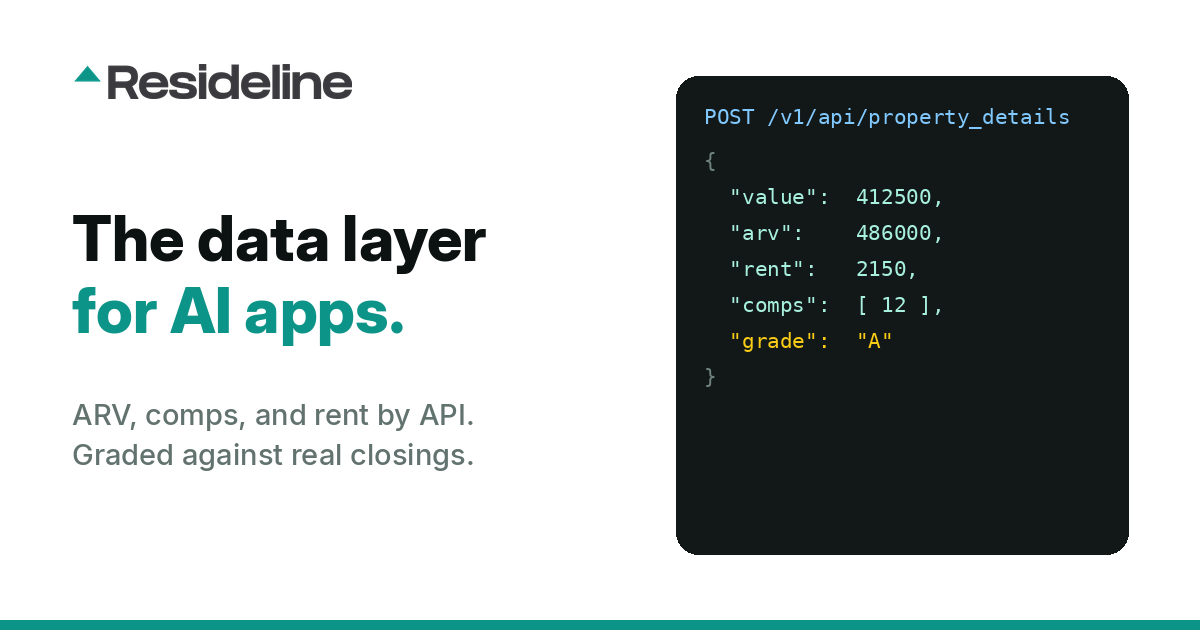
AI apps in proptech rarely fail because the model is not smart enough. They fail because the model gets asked a question that no amount of reasoning can answer: what is this specific house worth, what will it rent for, and what did the houses around it actually sell for.
A language model does not know that. It will guess, fluently, and your users cannot tell the difference until the guess costs someone money.
If you are building a deal-screening agent, an underwriting copilot, or a chatbot for agents, you need four things from the data layer:
- 1.A value for a specific address, including an after-repair value for the rehab case.
- 2.The comparable sales behind that value, not just the number.
- 3.A market rent estimate for the hold case.
- 4.Some way to know whether the number is right that does not reduce to a vendor marketing page.
Resideline exposes all four over a REST API and an MCP server. This is the developer tour: what the endpoints return, how to pick between REST and MCP, what it costs in credits, and where coverage actually stops.
What you can build
Deal-screening agents. Feed addresses from a wholesaler blast or an MLS export, pull value, ARV, and rent for each, return only the ones clearing a spread threshold. This is where credit budgeting matters most.
Underwriting copilots. An analyst pastes an address and gets value, comps, rent, and the arithmetic. The agent is not inventing the number, it is fetching it and explaining the comp set.
Lead scoring. Rank inbound seller leads by estimated value, or buyer leads by whether what they want exists in their price band. A nightly job over your CRM.
Portfolio monitors. Re-run values and rents on a schedule, alert on drift. No agent required, this is a cron job against REST.
Chatbots for agents. Where MCP earns its keep: the assistant calls a valuation tool mid-conversation and cites the comps instead of hand-waving.
Two ways in: REST API vs MCP
| REST API | MCP server | |
|---|---|---|
| Endpoint | https://resideline.com:2087 | https://resideline.com/mcp |
| Auth header | API-Key: your_api_key | Authorization: Bearer YOUR_API_KEY or X-API-Key |
| Best for | your own backend, batch jobs, cron, webhooks | assistants: Claude, Claude Code, Cursor, any MCP-capable agent |
| Who decides what to call | your code, at build time | the model, at run time |
| Surface | six documented endpoint groups | four tools |
| Setup | HTTP client plus a key | one config block or one CLI command |
| You get back | JSON you parse | tool results the model reads |
The MCP server is HTTP transport. Setup is one command:
claude mcp add --transport http resideline https://resideline.com/mcp \
  --header "Authorization: Bearer YOUR_API_KEY"
The Claude Desktop and Cursor JSON blocks are on the MCP server page. Four tools are exposed: analyze_property (full report: market value, sold comps, rent estimate, condition grade), get_property_value (sale value with range, confidence, top sold comps), get_rent_estimate (market rent min and max, projected yearly revenue, top rental comps), and get_accuracy_scoreboard (live graded accuracy stats, free, no key needed).
That last tool matters: your agent can cite live accuracy numbers in its own output, so confidence language in your product is sourced rather than invented.
The data you get
Every REST endpoint is a POST. Credit cost scales with the work:
| Endpoint | Credits | What it is for |
|---|---|---|
/v1/api/property_details | 1 | basic property information |
/v2/api/property_value | 2 | quick valuation |
/v2/api/property_report | 10 | full valuation with comps |
/v2/api/rent | 2 | rental analysis |
/v2/api/strlyzer | 5 | short-term rental analysis |
The details call takes a single required address string, full address including city, state, and ZIP:
curl -X POST "https://resideline.com:2087/v1/api/property_details" \
  -H "API-Key: your_api_key" \
  -H "Content-Type: application/json" \
  -d '{"address": "123 Main St, Miami, FL 33101"}'
Field names below are real, the values are illustrative:
{
  "address": "123 Main St, Miami, FL 33101",
  "lat": 25.7617,
  "lng": -80.1918,
  "property_info": {
    "beds": 3,
    "baths": 2,
    "sqft_size": 1850,
    "subject_year_built": "1995",
    "property_type": "Single-family",
    "images": ["https://..."]
  }
}
Comps ship with the value, not as a separate product
Every valuation returns the comps behind it plus a confidence score, and the selection rules are published: sold within the last 200 days, inside a 1 mile radius that expands when the tight ring is empty, scored on property type, square footage, beds, and baths, weighted by distance and recency, with distressed sales and foreclosures excluded and a minimum of three comparables when they exist.
For an AI app that is the difference between a number and an answer, so render the comps in your UI. In the Resideline app the comp criteria are adjustable, so a user who disagrees can change the inputs instead of losing trust in the output.
Multi-family runs on income rather than sales comps, using a gross rent multiplier: monthly gross rent times 12 times the market GRM, giving an as-is value on current rents and a potential value at market rents.
Accuracy you can verify
Every AVM vendor publishes an error number. Almost none publish a method you could falsify.
The Resideline method runs in public on a live scoreboard, in three steps: freeze, close, grade. Every day the model values homes that are still on the market and locks the prediction so it can never be edited. The market then decides. The frozen prediction is compared to the recorded sale price and the error is published, win or lose.
The distinction from a backtest is the direction of time. A backtest is fitted to outcomes that already exist. A prediction locked before the outcome exists is a bet, and bets can be lost in public.
Your app inherits the vendor error. If you auto-reject deals at a threshold, the spread of that error distribution is your false-negative rate. Read the current numbers off the scoreboard rather than hardcoding a figure from any blog post, including this one.
Pricing and credits
| Plan | Price | Reports per month | Includes |
|---|---|---|---|
| Free | $0 | 3, once at signup | Deal Analyzer and photo condition grading |
| Pro | $89/mo | 250 | Deal Inbox, branded PDF and CSV exports |
| Business | $249/mo | 1,000 | screening lists, API access, 3 seats |
MCP calls draw down the same monthly report allowance, with nothing extra to buy, and get_accuracy_scoreboard is free and needs no key. Rate limits are published per plan on the API reference, so budget credits first and requests second: the 10 credit full report is the expensive call.
Implementation notes
Auth. REST wants two headers on every request, API-Key: your_api_key and Content-Type: application/json. MCP accepts your key as Authorization: Bearer or X-API-Key. Keys come from your own account: log in, then reveal the key on your profile dashboard. Keep it server side, because if your front end can read the key, so can everyone else.
Error handling. Status codes are conventional: 400 invalid or missing parameters, 401 invalid or missing key, 403 insufficient credits or permissions, 404 property not found, 429 rate limited, 500 server error. Error bodies carry three fields, detail (human readable message), code (machine readable), and suggestion (recommended fix). Branch on code, log detail, pipe suggestion into your alerting.
// illustrative handler, not a published SDK
const res = await fetch(endpoint, { method: "POST", headers, body });

if (!res.ok) {
  const err = await res.json(); // { detail, code, suggestion }

  if (res.status === 429) return retryWithJitter(endpoint); // backoff, then retry
  if (res.status === 403) return haltAndAlertBilling(err);  // out of credits, do NOT retry
  if (res.status === 404) return markUnresolvable(err.detail);

  throw new Error(err.code + ": " + err.detail);
}
Treat 403 as a billing event rather than a transient failure. Retrying credit exhaustion in a loop only burns your rate limit.
Caching. Key your cache on a normalized address and set TTLs by volatility. Physical attributes barely change, so cache them aggressively. Values and rents move with the market, so use a much shorter window. Inside an agent loop, add a request-scoped memo so the model cannot re-fetch the same address three times in one conversation, usually the largest credit saving in an agent app.
Spend discipline. Screen cheap, then go deep. Resolve with the 1 credit details call, drop what fails to resolve, and spend the 10 credit report only on survivors. Dedupe the input list. Cap per-user spend so one runaway loop cannot eat the month.
Honest limits
Coverage stops somewhere. Live valuations run nationwide, and the public scoreboard grades them against real closing prices in 37 states, so the accuracy evidence is thinner elsewhere. Rental analysis reaches further, all 50 states. If your target market sits outside the valuation footprint, design the empty state instead of letting the model paper over the gap.
Rural comp density is thin. The comp engine starts tight and expands until it finds matches. In a dense suburb that covers a few blocks. In a rural county it can cross into a different submarket, and a sale a mile away in another school district is not really a comparable. Gate automated decisions on confidence, not on the point estimate alone.
Non-disclosure states. Texas does not put sale prices in the public record. That is why most valuation sources have no closing data there at all, and why blanket nationwide claims quietly exclude it. Resideline tracks closings directly rather than waiting on public record. Even so, verify coverage in non-disclosure markets yourself before you promise anything to a customer.
This is not an appraisal. An automated valuation is a statistical estimate, not a licensed appraisal and not a lending decision. Use it for screening, ranking, and triage, and put a human in the loop before money moves.
Start here
The full endpoint reference, per-endpoint request and response examples, error codes, and credit costs live at resideline.com/resideline-api. If you would rather your assistant call the data directly, the config blocks for Claude Desktop, Claude Code, and Cursor are at resideline.com/mcp-server. Start with the free scoreboard tool: no key needed, so you can confirm the connection before paying for anything.
Frequently Asked Questions
Is there a real estate API for AI apps that returns ARV, comps, and rent?
Yes. The Resideline REST API covers property details, quick valuations, full property reports with ARV and the sold comps behind them, long-term rent estimates, short-term rental projections, and zip-level market statistics. Every valuation includes the comps and a confidence score. There is also an MCP server at resideline.com/mcp so an assistant can call the same data directly. API access is included with the Business plan at $249 per month, and credit packs start at 100 credits for $15.
Should I use the REST API or the MCP server?
Use REST when your own code decides what to call: batch scoring, cron jobs, queue workers, backend services. Requests go to https://resideline.com:2087 with an API-Key header. Use MCP when a model decides at run time inside an assistant such as Claude, Claude Code, or Cursor. The MCP server exposes four tools, get_property_value, get_rent_estimate, analyze_property, and get_accuracy_scoreboard, and authenticates with Authorization: Bearer. MCP calls draw from the same monthly report allowance, and the scoreboard tool is free with no key.
How can I verify the property valuation API is accurate?
Resideline freezes a prediction while a home is still listed, waits for the real closing, then grades the frozen number against the recorded sale price and publishes the result on a public dashboard at resideline.com/accuracy. Predictions cannot be revised after the fact, which makes the scoreboard a running public bet rather than a fitted backtest. Check the live numbers rather than any figure quoted in an article, since they update daily. Coverage note: live sale valuations run nationwide and rental analysis covers all 50 states; the live scoreboard lists the states currently graded.
Check the numbers behind your next renovation deal.
Create a free account to inspect sale comps, model repair costs and work through your maximum offer.
Create a free account3 free reports at signup. No card required.