Using ChatGPT for Real Estate Deal Analysis: What Works and What Breaks
General AI is excellent at deal structure and math, and unreliable on values, comps, and rents because it has no live market data. Here is the split, the test to run, and the fix.
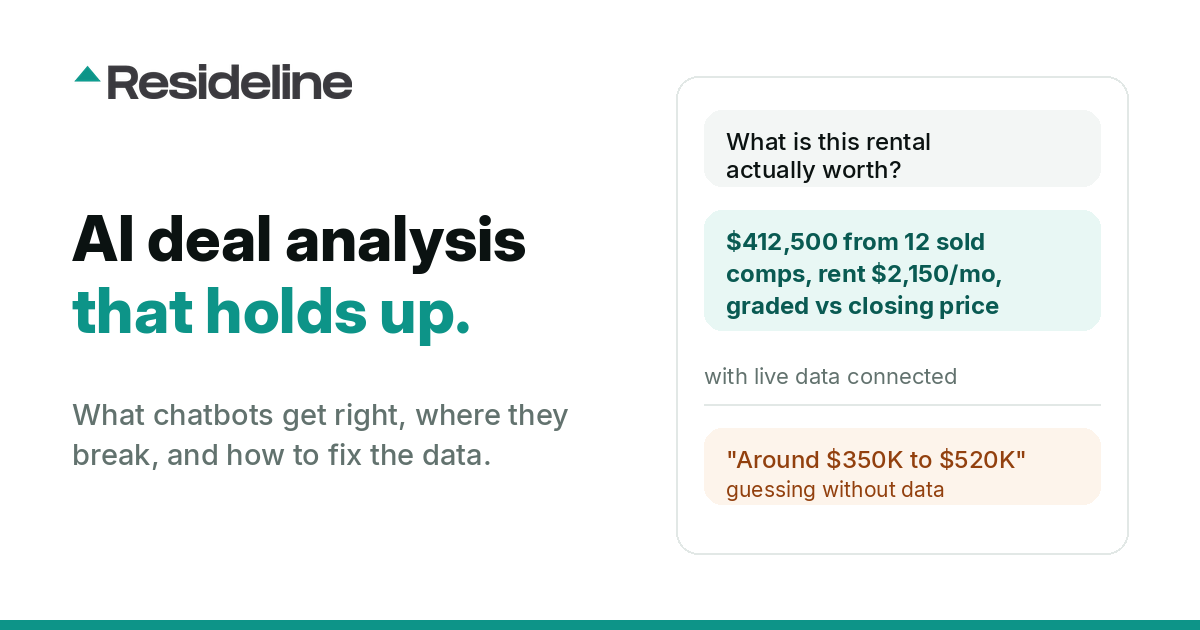
If you have ever pasted a property address into ChatGPT and asked "is this a good deal," you know the strange feeling that follows. The answer comes back fast, well organized, and confident. It walks the math cleanly. And somewhere in the middle of it sits an ARV, a rent figure, or a list of comps you have no way to verify, and that may have been invented thirty seconds ago. That is not a knock on the model, it is a description of what large language models are and are not. General AI is excellent at structure: sequencing the math, catching the expense you forgot, pressure testing an assumption you were being generous with. It is unreliable at facts about specific properties, because it has no live connection to market data and is built to produce a plausible answer rather than say "I do not know."
The workflow that holds up separates those jobs. Let the model reason. Give it real data to reason over.
What general AI is genuinely good at here
Walking the math out loud. Hand it your numbers and it lays out the chain from purchase price to cash flow to return, showing its steps so you can audit them.
Catching missed expenses. The highest value thing it does. Most blown pro formas are not blown on the value estimate, they are blown because nobody budgeted vacancy, capex reserves, turnover, or the actual insurance quote in a coastal county.
Sensitivity analysis. Ask it to break your deal on purpose.
Explaining structure. BRRRR refinance seasoning, cap rate versus cash on cash, 1031 timelines, how a draw schedule interacts with carrying costs. For builders, it organizes hard cost and soft cost line items into a spec pro forma before you call a sub for a real bid.
Drafting outreach. Seller letters, agent follow ups, contractor scope requests.
A prompt shape that works well:
You are reviewing my rental underwriting. Do NOT estimate the property
value or market rent, I will give you those. Your job is to audit my
assumptions and math. Purchase price: $310,000     Rehab budget: $42,000
Market rent (from comps): $2,450/mo
Loan: 75% LTV, 7.1%, 30 yr
Taxes: $4,200/yr   Insurance: $2,900/yr   HOA: $0

1. List every operating expense I have not accounted for, with a
   typical range for a single family rental.
2. Recompute cash flow, cap rate, and cash on cash with those added.
3. Tell me the rent and vacancy rate at which this deal breaks even.
That prompt takes fact finding away from the model and leaves it the reasoning. That is the whole trick.
Where it breaks
Ask a general chatbot what a specific house is worth, and three things go wrong at once.
It has no live listing data. A model is not connected to the MLS, to county records, or to current rental listings. Even with browsing on, it reads whatever public page it can reach, often an aggregator estimate, a stale listing, or a page about a different unit at the same address.
Its training data is time shifted. Whatever the model absorbed reflects a market that has already moved. When prices, rates, and rents all shift inside a year, a value grounded in older data is not slightly off, it is answering a different question.
It produces plausible numbers, not verified ones. A language model generates the most likely next piece of text, and a sale price of $412,000 on a street where prices run in the low $400s is extremely likely text. That is why hallucinated comps are so convincing: the street names are real, the zip is right, the beds and baths are reasonable, and the sale prices are fabricated. Nothing internally separates "I retrieved this" from "I generated this," so the confident tone reads identically either way. Rent estimates fail the same way, often worse, because rental comps turn over faster and are published less consistently than sales.
The test you should run
Pick a property you personally know, one you bought, sold, or lost at the closing table, where you know the real closing price. Open a fresh chat and ask:
Estimate the current market value of 123 Example St, Anytown, ST 00000
(3 bed, 2 bath, 1,540 sqft, built 1998). Give me a single number, then
list the 3 comparable sales you used with their addresses, sale dates,
and sale prices.
Compare the estimate to the actual closing price, then try to verify those three comps, addresses and sale prices both. Then open a second fresh chat and ask the identical question again. The gap between the model's own two answers is a free variance test, and it is usually wider than people expect. This is why Resideline publishes a public accuracy dashboard. Estimates are frozen at listing and later graded against the actual closing price, so the score reflects what the model said before it could possibly have known the answer. Any valuation source, ours included, should be willing to show you that.
Fixing the data layer
The fix is not a better prompt. It is giving the model a way to fetch real data instead of recalling it. That is what MCP (Model Context Protocol) does, an open standard that lets an AI assistant call external tools mid conversation. Instead of guessing a value, the assistant calls a valuation service, gets a real response with real comps, and reasons over that. The reasoning stays, the fabrication goes away. Resideline runs an MCP server at https://resideline.com/mcp with four tools:
| Tool | What it returns |
|---|---|
get_property_value | Value estimate plus the comparable sales behind it |
get_rent_estimate | Market rent estimate for the property |
analyze_property | Full deal analysis for the property |
get_accuracy_scoreboard | Live accuracy scoreboard, free, no API key required |
{
  "mcpServers": {
    "resideline": {
      "url": "https://resideline.com/mcp",
      "headers": { "Authorization": "Bearer YOUR_API_KEY" }
    }
  }
}
One honest caveat on the ChatGPT question, since it is probably what brought you here. MCP works today with assistants that support it, including Claude, Cursor, and other MCP clients. Whether ChatGPT can reach it depends on which connector and custom integration features your account and client version expose, and that surface changes often. Rather than promise a menu path that may not match your screen: check your assistant's current connector docs, and if it speaks MCP, the server above will work. Setup details are on the MCP server page. Live valuations run nationwide, and the public scoreboard grades them against real closing prices in 37 states. Plans are Free with 3 full reports at signup, Pro at $89 a month for 250, and Business at $249 a month for 1,000 with API access.
A workflow that actually holds up
- 1.Pull the real value and comps first, through a tool. Never let the conversation start with a number the model invented. Fetch the value, the rent, and the comp set, and put those on the table as given facts.
- 2.Run the deal math on those inputs. Purchase price, rehab, financing, holding costs, exit.
- 3.Verify against closed sales yourself. Open the comps the tool returned. Do they match the subject in size, age, condition, and location? If one crosses a boundary that matters in your market, throw it out and see what that does to the value.
- 4.Decide, and write down the assumption you are least sure of. Every deal has one, and naming it is how you learn whether your process or your luck is doing the work.
Step 3 is not optional, and no tool removes it. An automated value is an input to your judgment, not a replacement for it.
Free ways to start
The free calculators require no signup: ARV, BRRRR, cash on cash, rental property, rehab cost, and others. They are a good way to sanity check whatever number an AI hands you, because the math is fixed and visible. The get_accuracy_scoreboard tool is also free and needs no API key, so you can connect the server and see live accuracy data before creating an account.
The honest summary
General AI chatbots are a real upgrade to how you think about a deal and a bad source for what a property is worth. Use them for the expense checklist, the sensitivity analysis, the second opinion on your exit assumptions. Do not use them as a valuation engine, and be most skeptical exactly when the comps look tidy. If you want the reasoning and the real numbers in one conversation, connect a data tool and let the model call it. That is the point of the MCP server, and you can start with the free tools without spending a dollar. Illustrative note: dollar figures, addresses, and property details in the example prompts above are made up for demonstration.
Frequently Asked Questions
Can ChatGPT estimate a home's value accurately?
Not reliably. A general chatbot has no live connection to the MLS, county records, or current listings, and its training data reflects a market that has already moved. It generates a plausible number rather than a retrieved one, which is why the comps it cites often have real street names and fabricated sale prices. Ask the same question in two fresh chats and compare the two answers to see the spread for yourself. To get a real value, connect the model to live data through a tool rather than asking it to recall one.
What is ChatGPT actually good for in real estate deal analysis?
Structure and reasoning. It is strong at walking your deal math step by step, catching operating expenses you left out such as vacancy, capex reserves, and turnover, running sensitivity analysis to find the rent or rate at which a deal breaks, explaining BRRRR, cap rate, and 1031 mechanics, and drafting seller or contractor outreach. For builders it is useful for organizing hard and soft cost line items into a spec pro forma. Give it your verified numbers and let it audit the math.
How do I connect real property data to an AI assistant?
Use a tool connection. Resideline runs an MCP server at https://resideline.com/mcp with four tools: get_property_value (value plus comps), get_rent_estimate, analyze_property, and get_accuracy_scoreboard, which is free and needs no API key. Authentication uses a standard Authorization: Bearer header. It works with assistants that support MCP, including Claude, Cursor, and other MCP clients; whether ChatGPT can reach it depends on the connector features your account and client version expose, so check your assistant's current documentation.
Put the property research into practice.
Create a free account to explore property reports and put your deal research in one place.
Create a free account3 free reports at signup. No card required.