Back to Blog
Market Watch
July 30, 2026
7 min read

Indiana Housing Market 2026: Prices, Inventory & Trends

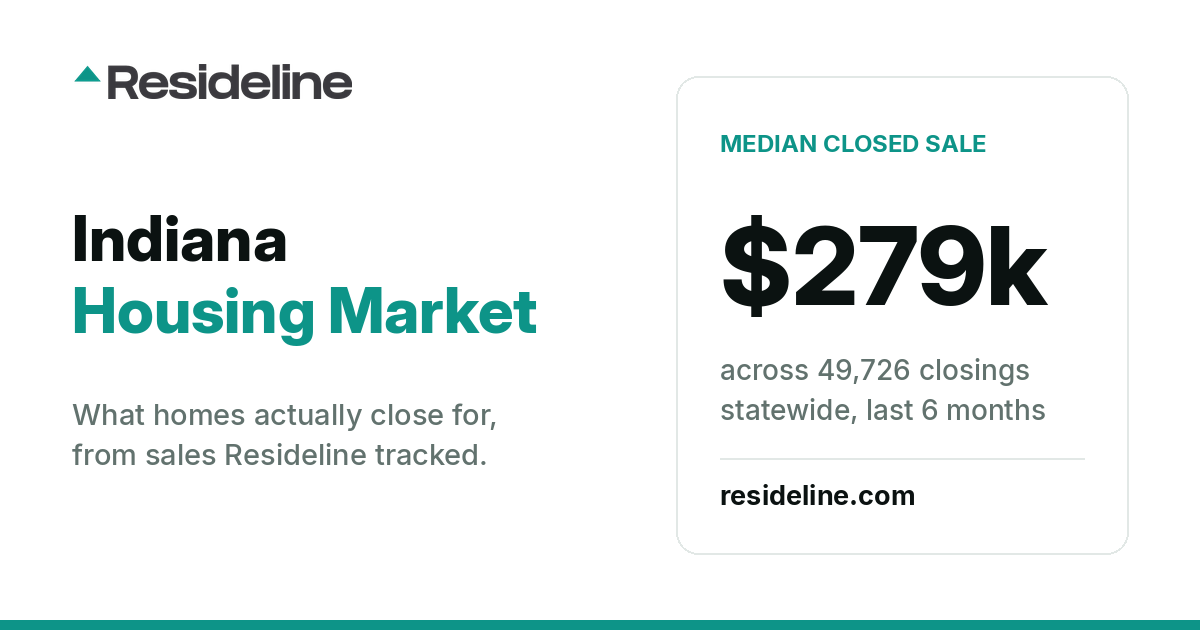
Indiana's median home closed at $278,000 across 36,288 sales in six months, and its largest markets are also among its cheapest.

Resideline Team
Indiana Housing Market 2026: Prices, Inventory & Trends

Indiana's median sold price is $278,000, and 36,288 homes closed across the state in the last six months, roughly 6,048 closings a month. Among states with this much transaction volume, Indiana is one of the few where the median home still trades under $280,000. That affordability is not evenly distributed. Carmel closes at a median of $625,000 while Gary closes at $124,050, a 5.0x spread inside one state. The statewide median is a midpoint between markets that operate on completely different scales. Asks are above closings, which is normal, but the size of the gap tells you something specific: the homes currently listed are a more expensive group than the homes that recently sold. Do not read this as evidence that every Indiana seller will take 14.7% off. Use that 3 day figure as a temperature reading rather than a prediction. The middle listing in Indiana is neither a Carmel new build nor a Gary rehab candidate, and those two properties behave nothing alike on timeline.

What the numbers mean for buyers versus sellers

For buyers, the practical implication of a $278,000 median with 36,288 closings behind it is that Indiana is one of the few states where a normal household or a small investor can transact at scale. Down payments at the state median are a fraction of what they are in coastal markets, and the volume means comparable sales are abundant almost everywhere. The catch is speed. Your competitive advantage in Indiana is not access, it is analysis speed and offer discipline. For sellers, the $41,000 spread is the warning. If you list near $319,000 in a market where the median closes at $278,000, you are joining the slower-moving segment. For investors, Indiana is one of the most legible states in the country. Indianapolis alone produced 4,871 closings at a $255,000 median, which is a rare pairing of major-metro liquidity with a below-median price. Add Fort Wayne at 2,749 closings and $275,000, and you have two large markets both trading at or below the state median.

The biggest markets in Indiana

These 12 cities account for 15,960 of Indiana's 36,288 closings, about 44.0% of all statewide activity. That is a more concentrated market than most, and the concentration is centered on the Indianapolis metro.

CityClosings (6mo)Median Sold Price
Indianapolis4,871$255,000
Fort Wayne2,749$275,000
Evansville1,591$225,000
South Bend1,190$205,000
Bloomington961$344,160
Lafayette771$284,000
Carmel685$625,000
Kokomo679$179,900
Fishers670$432,000
Elkhart630$236,000
Muncie601$176,000
Westfield562$500,000
Indianapolis and its northern suburbs are the story. Indianapolis, Carmel, Fishers, and Westfield combine for 6,788 closings, but the price range across those four runs from $255,000 to $625,000. That $370,000 spread across a single contiguous metro is the single most important fact for anyone underwriting Indiana property. A comparable sale that crosses from Indianapolis into Carmel is not a comparable sale. Outside Indianapolis, the pattern is affordability with volume. Evansville at $225,000 on 1,591 closings, South Bend at $205,000 on 1,190, Kokomo at $179,900 on 679, and Muncie at $176,000 on 601 are all substantially below the $278,000 state median while producing hundreds or thousands of transactions. Bloomington at $344,160 is the notable exception among mid-size markets, closing $66,160 above the state median on 961 sales.

Where the affordable markets are

Indiana has 15 cities with at least 100 closings in the last six months and a median sold price at or under $205,000. Gary is the cheapest in this batch of states at $124,050 with 313 closings, followed by Peru at $149,900 and Richmond at $150,000. What sets Indiana apart is that several of its highest volume markets are also among its cheapest. South Bend produced 1,190 closings at a $205,000 median. Kokomo produced 679 at $179,900. Muncie produced 601 at $176,000. Anderson produced 389 at $177,950. In most states, low price and high volume are mutually exclusive. In Indiana they overlap repeatedly, which means you can find a low entry price without accepting a thin, hard-to-exit market. We rank all 15 of those cities by entry price, with the closing counts that determine liquidity, in our best places to buy rental property in Indiana guide. For neighborhood detail beneath these city medians, the local market pages go to the ZIP level.

How to analyze a specific Indiana property

A $278,000 statewide median tells you almost nothing about a specific house in a state where city medians range from $124,050 to $625,000. The sequence that works:

See the comps and adjust them yourself. Resideline shows the comparable sales behind every valuation and lets you edit the set. In the Indianapolis metro, where four adjacent cities span $370,000 at the median, a comp that silently crosses a municipal boundary can destroy a valuation. Visible comps let you catch that before you write an offer. Value the condition, not the average. Resideline estimates property condition from the listing photos. In markets where the median is $124,050 or $150,000, the difference between a maintained house and a shell is most of the deal, and it is not in the tax record. Set the after repair value first. Use the ARV calculator to establish a defensible finished number, then subtract your rehab budget and required margin to arrive at a maximum offer. Underwrite the hold on its own terms. The rental property calculator handles taxes, insurance, vacancy, and management. A low purchase price does not create cash flow by itself, and Indiana property tax treatment differs between owner occupied and non-owner occupied property in ways that materially change a rental pro forma. Then test the whole deal. The deal analyzer combines purchase, rehab, holding costs, financing, and exit so you can see which single assumption the return depends on. On whether the valuations hold up: Resideline freezes its estimate when a property lists and later grades that frozen number against the actual closing price, with results published on a public accuracy dashboard. Live valuation coverage currently spans 31 states, so check your target market in the tool. The free calculators require no signup, so you can run an Indiana address right now.

Frequently Asked Questions

Is Indianapolis expensive compared to the rest of Indiana?

No. Indianapolis closes at a $255,000 median, which is $23,000 below the state median, while producing 4,871 closings, more than any other Indiana city. Its northern suburbs are a different story: Carmel closes at $625,000 and Westfield at $500,000.

Ready to Start Investing Smarter?

Join 2,000+ investors using Resideline.
Start free with 3 reports a month.

Start Free

Keep reading

All articles