Condition Is the Blind Spot in Automated Home Valuations
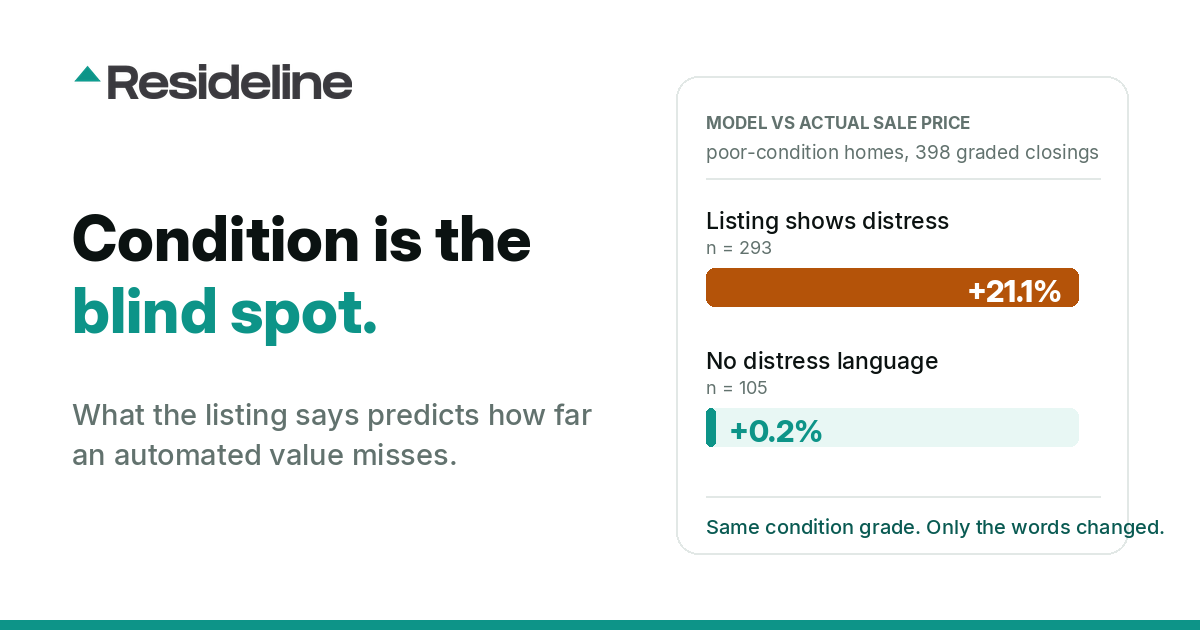
Redfin asked us what appraisers look for. The answer, condition, is also what automated valuations miss most: on distressed listings our model ran 21% above the real sale price, while identical homes without distress language were unbiased.
Redfin asked us what home appraisers look for when they size up a property. Our answer came down to one word, and it is the same word that explains why automated valuations get certain homes badly wrong.
Condition.
We were featured on Redfin! Read the full article here: What Do Home Appraisers Look For in a House to Determine Its Value?
The thing a model cannot see
An appraiser walks the property. They see the roof, the furnace, the water stain on the ceiling, the kitchen nobody has touched in thirty years. An automated valuation sees a spreadsheet: beds, baths, square footage, lot size, and what sold nearby.
This is not a Resideline problem or a Zillow problem. It is structural to the whole category, and Redfin says so about its own estimate, which cannot see kitchen renovations, roof replacements, deferred maintenance, or a basement that flooded. Every automated valuation makes the same silent assumption, that the home being valued is in roughly the same shape as the homes it is compared against.
For most properties that assumption is harmless, because most homes are ordinary and get compared to other ordinary homes. It breaks on exactly the properties investors care about. It breaks hardest in what we call two-market cities, where renovated and distressed stock trade at multiples of each other on the same streets.
What we measured
We freeze our estimates while homes are still listed and grade them against the real closing price. That gave us a way to test the condition problem instead of arguing about it.
We took a sample of closed sales, scored each property's condition from its listing photos, and separately flagged whether the listing text carried distress language: fixer, needs work, sold as is, handyman, TLC, cash only, and about a dozen other phrases agents actually write. We later ranked every US metro by how often that language appears, in the distress language index.
Then we compared what the model predicted against what each home really sold for.
- •Poor-condition homes whose listings also carried distress language: the model came in 21% above the eventual sale price, across 293 closings.
- •The same condition grade with no distress language: 0.2% above. Effectively unbiased.
- •All condition grades, listings with distress language: 15% above, across 881 closings.
- •Listings without it: 1.8% below.
The gap between those first two lines is the whole finding. Same photo-derived condition grade, same model, same markets. The only thing that changed was what the listing said, and it moved the error by more than twenty points.
Why the words work when the data fields do not
Here is the counterintuitive part. Structured condition data is close to useless for this. An explicit condition score is missing on most records, and when we checked whether homes in poor shape simply use more distress keywords than normal homes, the base rates came back nearly identical.
Sellers market their homes. Nobody writes "needs work" unless they have already decided to price for an investor.
That decision is the signal. Distress language is not really a description of the property, it is a declaration of how the property is being sold. An agent who writes "sold as is, cash only" has concluded that retail buyers and their lenders are out of the picture, and has priced for who is left. The words are a pricing decision leaking into the text, which is why they separate so cleanly when the structured fields do not.
The research points the same way
Our number is not an outlier. The academic literature reached a similar place from a completely different direction.
Conventional studies of distressed sales, which cannot control for property condition, put the discount somewhere between 20% and 27%. The canonical estimate, from a 2011 paper in the American Economic Review, is 27%.
A 2023 study in the Journal of Urban Economics then did something clever. Using appraisal records, the authors controlled for the quality and condition that earlier work could not observe. The discount collapsed to roughly 5%, which they attributed to the stigma of distress itself.
Put those two results side by side and the arithmetic tells the story. Somewhere between 15 and 22 percentage points of what the market calls a distressed-sale discount is not distress at all. It is condition, appearing as a discount only because the model doing the measuring could not see the house.
Our own figures, 15% to 21%, come from production valuations rather than regression coefficients, and land inside that range.
What we did about it
Measuring a bias is not the same as fixing it, and the obvious fix is wrong.
We tested a flat discount on every poor-condition home and it made accuracy worse. That population straddles zero. Plenty of poor-condition homes are already valued correctly or even a little low, and cutting all of them pushes the accurate ones into error.
What works is a gate. Only homes that are both graded poor condition and carrying distress language receive a discount, and it applies to the as-is value rather than the after-repair value. We validated it on a fresh batch of closings the model had never seen before it went near production, and the effect held.
Homes showing no distress signals are left alone. That restraint is the point. A valuation earns trust by being right about ordinary houses, and you do not spend that trust chasing an edge case.
What this means if you are buying
Read the listing text before you trust any estimate. If it says as is, cash only, or handyman, assume every automated number you are looking at, ours included, is anchored to a version of that house that does not exist.
Renovated comps are the trap. A neglected property compared against renovated ones inherits their finishes on paper, and that mechanism is behind most of the large over-valuations we see.
Ask what the number is actually measuring. After-repair value and as-is value answer different questions. A tool that returns a single number for a house needing forty thousand dollars of work is answering neither one well.
The receipts
Every Resideline estimate is frozen while the home is still for sale, then graded against the real closing price after it sells. The public scoreboard shows 3.60% median error across 26,522+ graded closings in 37 states, and you can read it at the live accuracy dashboard.
Run any address through Resideline and you get the value, the sold comps behind it, and a condition-aware as-is number in the same report.
Frequently Asked Questions
Why is my automated home value estimate wrong?
The most common reason is condition. Automated valuation models work from beds, baths, square footage and nearby sales, and cannot see a worn roof, an aging furnace or a kitchen that has not been updated. When we measured our own valuations against real closings, homes in poor condition whose listings carried distress language came in 21% above the eventual sale price, while the same condition grade with no distress language was effectively unbiased.
Do Zillow and Redfin estimates account for home condition?
Not directly. Redfin states that its estimate cannot see kitchen renovations, roof replacements, deferred maintenance or basement flood damage, and the Zestimate has the same limitation. This is structural to automated valuation rather than specific to any one product, because none of these tools go inside the house.
How much less does a home in poor condition sell for?
Research suggests the majority of what is usually called a distressed-sale discount is really condition. Conventional studies put distressed discounts at 20% to 27%, but a 2023 Journal of Urban Economics study that controlled for condition using appraisal records found only about 5% remained. That implies roughly 15 to 22 percentage points is condition itself.
What is the difference between as-is value and after-repair value?
After-repair value is what a property is worth once the work is finished. As-is value is what it is worth in its current state. For a house needing significant work the two numbers can differ substantially, and a valuation that reports only one of them is not answering the question an investor is asking.

About the author
Jeffrey Batista
Jeffrey Batista is the founder of Resideline, a real estate technology company building institutional grade valuation and investment analysis tools for real estate investors.
A software engineer with more than 10 years of experience, Jeffrey has worked across full stack development, infrastructure, data engineering, machine learning, and large scale systems. He left his engineering career to build Resideline full time.
Jeffrey is also a real estate investor with nearly a decade of hands on experience buying, renovating, managing, and analyzing residential properties. His experience on both sides of the industry, as an engineer and an investor, led him to build Resideline after seeing how fragmented and outdated many of the tools available to individual investors were.
Today, he leads the development of Resideline's proprietary data infrastructure, automated valuation models, rental analytics, and investment underwriting technology.
How does your property compare with nearby sales?
Create a free account to inspect comparable properties and assess the assumptions behind the estimate.
Create a free account3 free reports at signup. No card required.