How Accurate Are Home Value Estimates, and When to Trust One
Every estimator quotes an accuracy number. Three questions reveal whether that number applies to your deal.
Every valuation product quotes an accuracy number, and the honest answer to “how accurate are they?” is: it depends which homes got counted. Published error rates are typically measured on the easiest possible set.
Before you lean on any estimate, ours included, put three questions to it: the sample, the distribution, and the timing.
The three questions
What was the sample?
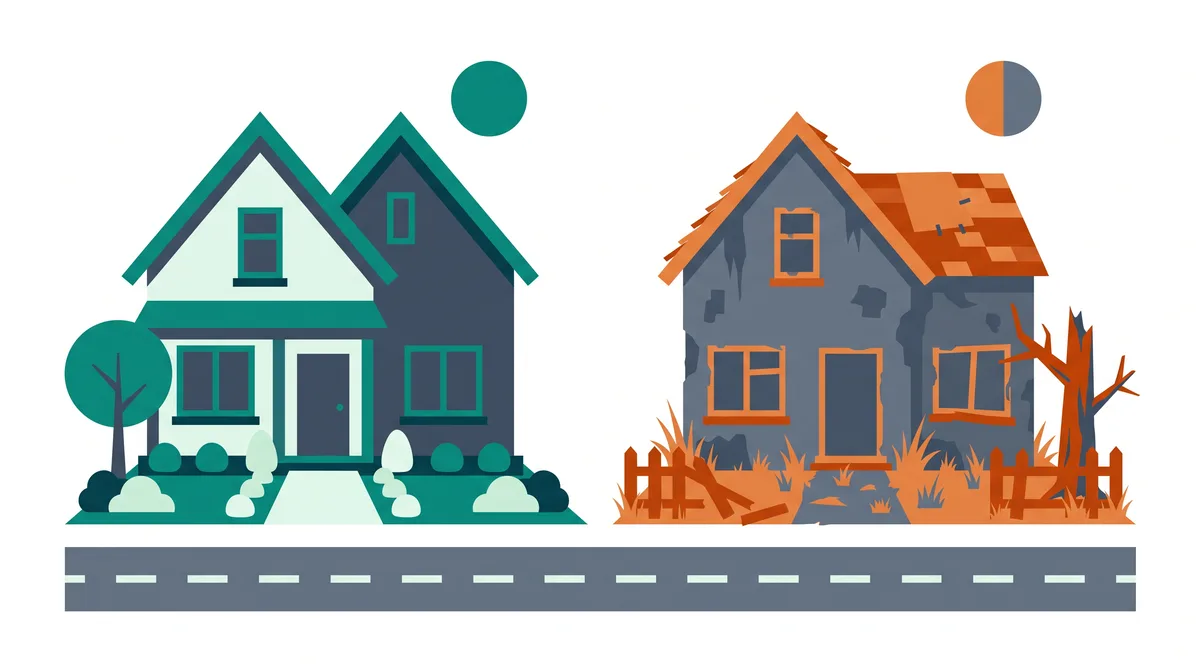
Error rates are usually computed on homes that recently sold on the open market: marketed, photographed, mostly decent condition. Off-market homes and rough-condition properties are harder to value, and they often sit outside the headline number entirely. If you buy distressed properties, a stat measured on tidy retail sales overstates what the model will do for you.
What does the distribution look like?
A median error describes the middle of the pack and says nothing about the tail, and the tail is where a deal dies. Ask what share of estimates land within five percent, and what share miss by more than twenty.
When was the estimate made?
This is the subtle one. Honest measurement locks the number in before anyone knows the outcome, then grades it against the eventual closing price.
If a model’s “prediction” is recorded after the home goes under contract, it is not a prediction. It is a recall of the list price, and it will look flawless on paper while telling you nothing.
Same median, different risk
Two models can share a 4% median while one misses by 20% or more five times as often. The headline is identical; the risk is not.
| What you can check | Model A | Model B |
|---|---|---|
| Median error | 4% | 4% |
| Misses of 20% or more | 1x | 5x as often |
The share of estimates that miss by more than twenty percent is the number that determines whether an estimate can hurt you. Ask for it by name.
How Resideline grades itself
Our values are recorded while homes are still listed, then graded against the eventual closing prices. The result: a 3.26% median error across more than 9,500 graded closings, updated daily, in public.
The scoreboard shows the distribution, not just the median, because the distribution is the number an investor actually needs.
Open the accuracy page and read the error histogram, not just the headline. Then put the three questions to every estimate you use anywhere: the sample, the distribution, the timing. A vendor that will not answer them is answering them.
Put this lesson to work on a live address.
See the live accuracy scoreboard